Get Full Government Meeting Transcripts, Videos, & Alerts Forever!
Get email alerts on the Education Military topic
No spam. Unsubscribe anytime.
Panel reviews technical updates to interstate compact protecting military children (HB118)
Summary
Representative Ed Buttry introduced House Bill 118 to update Montana’s participation in the Interstate Compact on Educational Opportunity for Military Children, revising federal citations and changing state assessment language to use the compact’s per-student amount.
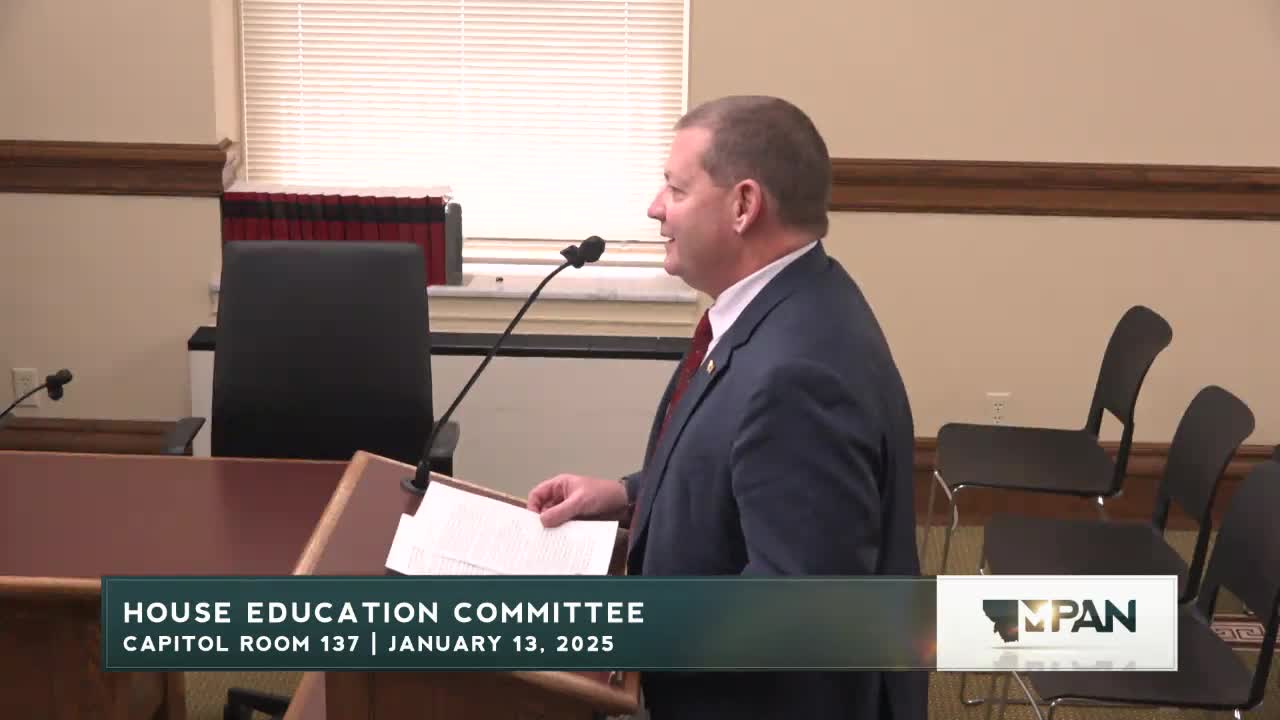
Representative Ed Buttry introduced House Bill 118 to update Montana’s participation in the Interstate Compact on Educational Opportunity for Military Children, telling the House Education Committee the bill revises federal citations and changes how Montana’s annual compact assessment is calculated.
"I'm Representative Ed Buttry. I represent House District 21," Buttry said as he opened the hearing. He told the committee the bill updates U.S. code citations in several places and replaces an existing $2-per-military-child cap and a $5,000 annual ceiling with the per-student amount and maximum set by the interstate compact.
The change removes a fixed $2-per-child figure that has been in state law since Montana joined the compact in 2013 (Senate Bill 202) and replaces the $5,000 maximum with the compact’s formula, Buttry said. "There's just a few minor changes in house bill 118...the first revision is to change federal citations in the bill to match current United States code sections," he said. He added later that the fiscal note shows the changes "result in no fiscal impact to the state."
Rob Watson, executive director of School Administrators of Montana, testified in support. "I've read through this bill several times. I know it's really important to a lot of our communities that serve military children," Watson told the committee.
Committee members asked for additional details the sponsor did not have at the hearing. Representative Seekins Crowe asked how many military-connected students the state serves; Buttry said he did not have current numbers and that the Office of Public Instruction (OPI) maintains that information. Representative Thain asked whether a separate statutory citation referencing the $2-per-child charge in a withdrawal clause also needed updating; Buttry said he would check with the compact commission and report back.
Buttry described how compact membership funds the compact commission’s arbitration, policy work and an annual meeting that supports interstate coordination: "They do a lot of counseling of different states...That's what they use the cost for." He said the commission helps ensure military-connected students aren’t penalized when families move between states because of military service.
The sponsor asked the committee for a "due pass." The hearing concluded without a recorded committee vote on HB118.
Why it matters: The compact is intended to protect military-connected students’ enrollment, graduation timelines and participation in activities when families move across state lines; the bill is largely technical but alters how Montana’s share of compact costs will be set going forward.