Get Full Government Meeting Transcripts, Videos, & Alerts Forever!
Get email alerts on the Uniform Electronic Legal Material Act topic
No spam. Unsubscribe anytime.
Committee hears bill to allow official electronic Montana legal code
Summary
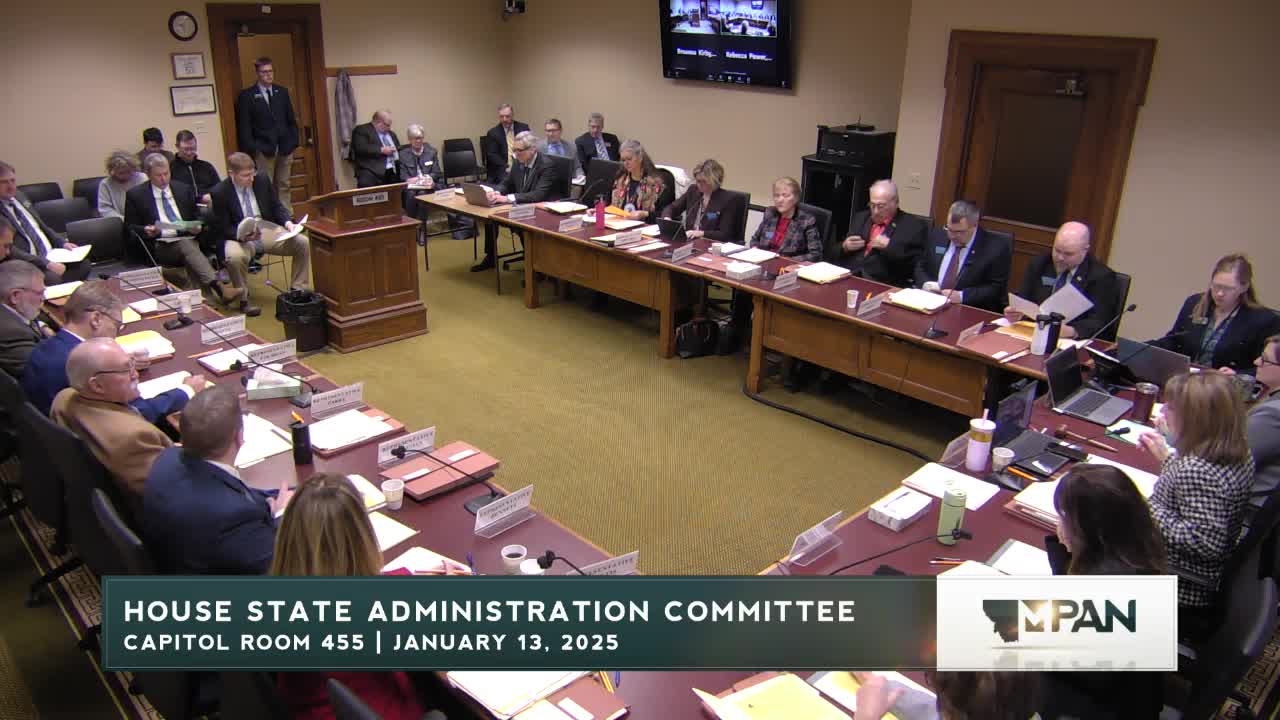
House Bill 111 would let the legislative branch designate official electronic versions of Montana’s constitution, session laws and the Montana Code Annotated and add procedures to authenticate and preserve those materials, sponsors and witnesses told the House State Administration Committee.
Representative Steve Fitzpatrick, sponsor and member for House District 24, opened the hearing on House Bill 111, saying the bill would "adopt the Uniform Electronic Legal and Material Act" and provide a framework to "authenticate the materials, to verify that they're a true and accurate copy" if the state chooses to make electronic records official.
The bill would allow the legislative co-commissioner and Legislative Council to designate electronic versions of the Montana Constitution, the session laws and the Montana Code Annotated as official, establish authentication and preservation procedures, and require backup and recovery of those electronic materials, witnesses told the committee.
Why it matters: Jared Coles, a nonpartisan attorney in the Legislative Services Division who drafted the bill, told the committee that under current Montana law the printed volumes remain the only official copy. "Those are the official laws in Montana at this point in time," Coles said, and the bill would give the co-commissioner the ability to designate an electronic record as official so the public and practitioners can verify online copies. He also noted the bill does not force the office to abandon printed books.
Supporters included Jacqueline Landmark, identified as one of Montana’s Uniform Law Commissioners, who said the Uniform Law Commission drafts nonpartisan model acts for states and "I enthusiastically support this legislation." Bruce Spencer, speaking for the State Bar of Montana, said the profession has shifted to electronic materials and urged passage.
Coles and other witnesses described practical limits and costs: the bill would not require the Legislature to go fully electronic; converting to authenticated electronic publication is a policy choice for Legislative Council and the co-commissioner and the fiscal note estimates initial IT costs in fiscal years 2026–27 to develop authentication. Coles said some states have implemented similar systems at much lower expense, while Montana's fiscal note is conservative. He added that action to make electronic records official would depend on funding and policy decisions.
No opponents testified. The committee closed the hearing after questions about the fiscal note and implementation timeline.
The committee did not take a vote during the hearing; the bill will proceed through the committee process for possible executive action later.