Get Full Government Meeting Transcripts, Videos, & Alerts Forever!
Get email alerts on the Hb103 Rail topic
No spam. Unsubscribe anytime.
Bill would sweep portion of railcar tax to fund expanded state rail inspections; PSC and rail program argue staffing shortfall
Summary
House Bill 103 would create a statutory special‑revenue appropriation from a portion of the railcar tax to fund expansion of Montana’s railroad inspection program, adding inspectors to address a broad rail network and perceived coverage gaps, agency and railroad program staff told the committee.
A bill introduced in the interim would transfer a portion of Montana’s railcar tax into a statutory special‑revenue account to fund an expanded state railroad inspection program, Public Service Commission and railroad program officials told the appropriations committee on Wednesday, and LFD staff said the revenue available would be a small share of current railcar tax collections.
“The difference this time is the energy and telecommunications interim committee brought a bill to address the problem… House Bill 103 will be heard in House Energy on Wednesday,” Brad Molnar, executive officer of the Montana Public Service Commission, told the committee. The bill’s funding mechanism, as drafted in the version shown to the committee, would sweep 8 percent annually of the railcar tax into a statutory state special revenue account to be used by the PSC for railroad inspections, Molnar said.
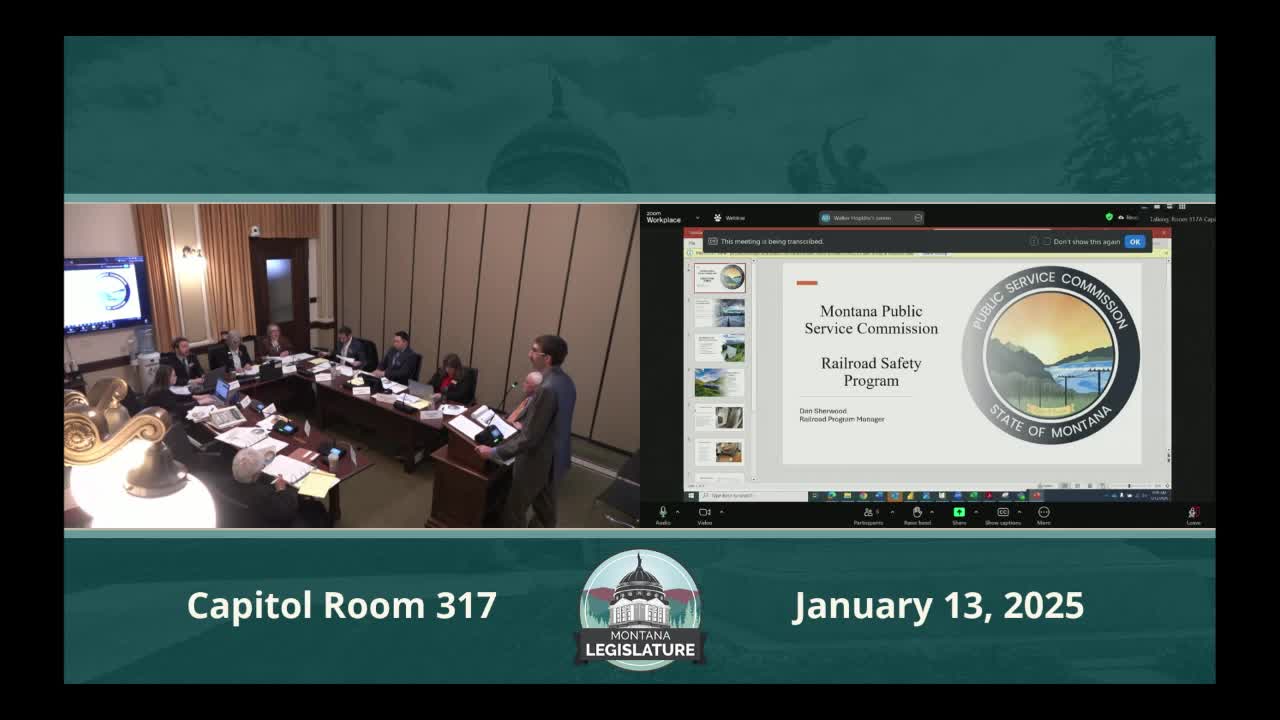
Dan Sherwood, the PSC’s railroad program manager, said Montana’s state program currently enforces federal railroad safety rules under a multiyear agreement with the Federal Railroad Administration and participates in 49 C.F.R. part 212 state safety participation. “We primarily operate enforcing federal regulations due to preemption from the Railroad Safety Act of 1970,” Sherwood said. He described the current Montana program as limited to the motive, power and equipment (MP&E) discipline with two inspectors (an eastern and a western inspector) and urged expansion across additional disciplines.
Sherwood told the committee that Montana has roughly 3,680 track miles — a large and geographically dispersed rail network — and that most neighboring states participating in the federal state‑participation program enforce multiple inspection disciplines. He described priorities for state inspections as focusing on mechanical defects that can cause derailments, brake and draft‑gear issues, and compliance with blue‑signal worker protections. “The number one cause of derailments both in Montana and nationally… is track,” Sherwood said when asked about causes of derailments.
Under the bill as discussed before the committee, the draft would fund additional inspectors and program staff. LFD staff told the committee the railcar tax has produced about $3.8 million to $4.0 million per year in recent years; an 8 percent sweep of that revenue would produce roughly $340,000 annually to fund positions, LFD staff said. Committee staff and PSC witnesses noted that railcar tax receipts have fluctuated and that using a portion of a volatile revenue source to fund ongoing personnel carries risk.
Sherwood and Molnar said the Federal Railroad Administration currently assigns two MP&E inspectors to Montana but that FRA staff cover multiple states and are stretched thin; state participation is intended to supplement federal coverage. Sherwood described the state program’s enforcement options (comments, defect orders that prevent movement of equipment until repaired, civil penalties, special notice for repair and individual liability) and described the training and certification that state inspectors receive through the FRA.
Committee members asked for data comparing Montana’s inspection program and derailment history with neighboring states (Washington, Idaho) and for a recent trend analysis of railcar tax receipts. LFD staff agreed to provide a follow‑up on the railcar‑tax trend and on comparisons of program size and derailment rates between Montana and other states. The committee did not take formal action on House Bill 103 at the hearing; Molnar said the bill will proceed to a hearing in the House Energy Committee.