
Charter School Commission reports enrollment growth, highlights funding gaps and seeks targeted per‑pupil and differential support
Get AI-powered insights, summaries, and transcripts
Subscribe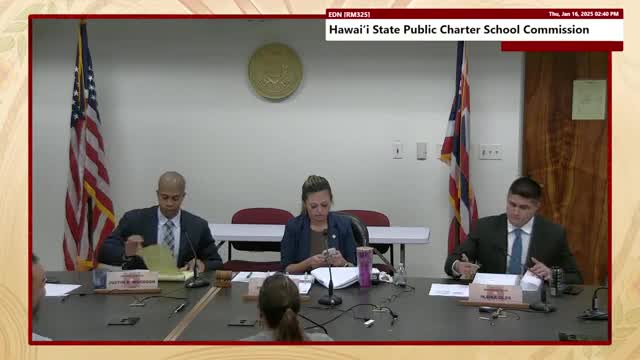
Summary
Mokalapua Lancaster, chair, and Ed Ngo, executive director of the Hawaii Public Charter School Commission, told the House Committee on Education that Hawaii’s charter sector enrolls about 13,054 students across 38 charter schools and that the commission seeks targeted funding to address teacher differentials, early learning and facilities constraints.
Mokalapua Lancaster, chair of the Hawaii Public Charter School Commission, and Executive Director Ed Ngo told the House Committee on Education that Hawaii’s public charter sector now includes 38 charter schools across five islands with enrollment of about 13,054 students and that the commission is seeking targeted state funding for teacher differentials, early learning and administrative capacity.
The commission reported that 17 or more charter schools identify as Hawaiian‑focused and that 11 charter operators include preschool programs attached to charter campuses. Lancaster and Ngo described charter growth as limited by facilities and noted long waiting lists at multiple campuses.
The commission highlighted academic growth performance using STRIVE HI indicators: 20 of 35 charter schools with recordable data met or exceeded student growth percentiles in at least one subject, with average growth percentiles above statewide benchmarks in several areas. Ngo also cited Hawaii P‑20 analyses that showed charter 11th graders had a modest advantage on some achievement measures and higher participation in dual credit courses per capita.
On funding, the commission explained that charter per‑pupil funding is derived from Department of Education budget program IDs and is paid from EDN 600 (the per‑pupil lump sum). The commission said its EDN 600 per‑pupil figure is currently $11,055. Ngo said EDN 600 is not differentiated and therefore does not target funds to specific needs; the commission requested that more funds be appropriated to EDN 612 (commission administration and targeted program support) so it can distribute resources for teacher differentials (hard‑to‑staff and Hawaiian immersion) and early‑learning needs more quickly and equitably.
Ngo summarized the EDN 612 requests presented to the finance committees: commission operations (about $1.8 million), early learning (about $9.1 million) and Hawaii Keiki Ready to Learn (about $1.5 million). The commission described the per‑pupil formula as a statutory mechanism that yields a lump‑sum amount placed in the charter allocation; facilities, dedicated special‑education staffing and some other targeted funding streams (for example EDN 150 special‑education allocations) flow through different mechanisms and are not automatically included in the EDN 600 per‑pupil lump sum.
The commission described a pilot pre‑K charter model (Parkway Village) sited inside an affordable housing development that would provide free public pre‑K and enable wraparound private early‑childcare providers to deliver before‑ and after‑care to working families. Parkway Village and other potential providers have nine classrooms currently open for application, the commission said.
Commissioners acknowledged the funding strain on charters for facilities, repair and maintenance, and collections such as FICA and workers’ compensation. Ngo and finance staff said many charter schools fill funding gaps with grants and fundraising because the per‑pupil allocation is undifferentiated. The commission did not present formal votes in the briefing; commissioners asked for legislative consideration of targeted per‑pupil adjustments and transfers to EDN 612 to address teacher differentials and early‑learning growth.