
Assembly passes multiple 'rules report' bills after floor criticism of chapter amendment process
Get AI-powered insights, summaries, and transcripts
Subscribe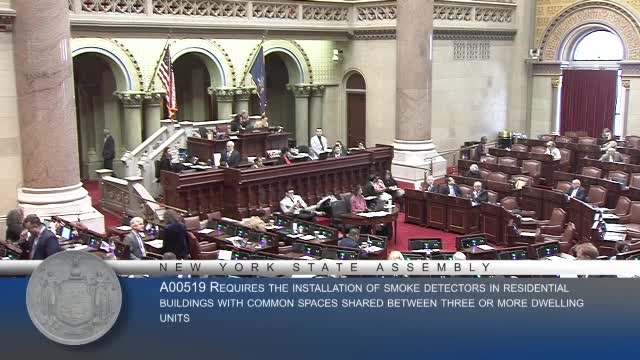
Summary
The New York State Assembly approved four bills described as "rules reports" that amend the Executive Law, while one lawmaker used his explanation of vote to criticize the annual "chapter amendment" process as opaque.
The New York State Assembly on Jan. 13, 2025 passed four bills labeled as rules reports that would amend the state Executive Law, voting unanimously or nearly unanimously on each measure.
Members recorded passage of Assembly Bill 519 (rules report 2), Assembly Bill 596 (rules report 3), Assembly Bill 693 (rules report 4) and Assembly Bill 1020 (rules report 5). The bills carried varying effective dates: several were designated to take effect immediately, and one was set to take effect on the 90th day after enactment.
The votes were announced on the floor as follows: Assembly Bill 519 was approved, Ayes 145, Nays 0; Assembly Bill 596 was approved, Ayes 147, Nays 0; Assembly Bill 693 was approved, Ayes 146, Nays 1; and Assembly Bill 1020 was approved, Ayes 148, Nays 0.
During debate on Assembly Bill 519, Assembly Member Ra used his explanation of vote to criticize the chapter amendment process, calling it “one of the least transparent things we do in this government each and every year.” He said chapter amendments are often presented as prearranged deals between the governor and a sponsor and that the process can shield politically sensitive changes from broader legislative scrutiny. Ra said some chapter amendments add provisions colleagues on the floor have previously raised in debates, while others expand gubernatorial power; he said the legislature should evaluate amendments “on their merits” rather than assume automatic approval. Ra concluded by saying he would vote in the affirmative on the bill while urging changes to how chapter amendments are handled.
Assembly Member Roth was recorded as answering in the affirmative during the floor proceedings; beyond the explanation of vote from Ra, floor remarks were limited and clerks promptly recorded and announced the tallies.
Clerks read the final sections of the bills on the floor; for those bills designated to take effect immediately the clerk announced "This act shall take effect immediately." For Assembly Bill 693 the clerk read that "This act shall take effect on the 90th day." After the votes, the speaker's office advanced the A calendar and the Assembly adjourned until the next scheduled session date.
The bills were presented as amendments to the Executive Law; the measures were reported under the Assembly rules reports and carried forward through the standard floor vote process. No committee reports with detailed legislative findings or the full text of each amendment were read into the record during the floor action excerpted in the transcript.
Votes at a glance
- Assembly Bill 519 (rules report 2): an act to amend the Executive Law; final vote announced Ayes 145, Nays 0; effective immediately (as read on the floor). Outcome: approved. - Assembly Bill 596 (rules report 3): an act to amend the Executive Law; final vote announced Ayes 147, Nays 0; effective immediately (as read on the floor). Outcome: approved. - Assembly Bill 693 (rules report 4): an act to amend the Executive Law; final vote announced Ayes 146, Nays 1; effective on the 90th day (as read on the floor). Outcome: approved. - Assembly Bill 1020 (rules report 5): an act to amend the Executive Law; final vote announced Ayes 148, Nays 0; effective immediately (as read on the floor). Outcome: approved.
Context: "Chapter amendment" criticism and next steps
Assembly Member Ra’s floor remarks framed the four bills within the recurring practice known as chapter amendments—end-of-session technical or policy changes appended to other legislation. Ra described the chapter amendment process as lacking transparency and urged that each amendment be considered on its merits rather than treated as pre-approved because of gubernatorial support. He did not propose a specific procedural remedy on the floor during his explanation of vote.
No additional committee or legislative deadlines were announced on the floor during the recorded excerpt, and clerks indicated the Assembly would reconvene at the next scheduled session date listed by the speaker’s office.