Hawaii Teacher Standards Board expands licensure data collection, pilots Educators Rising and pursues registered teacher apprenticeship
Summary
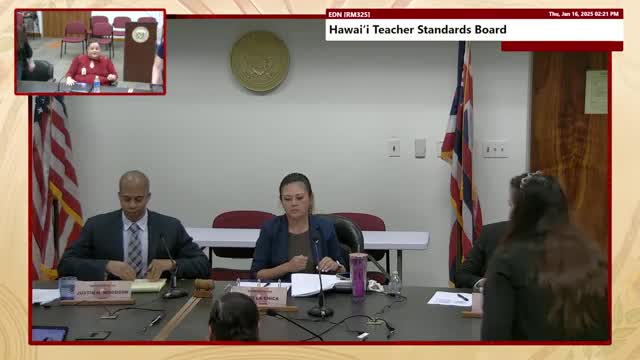
Felicia Villalobos, executive director of the Hawaii Teacher Standards Board, told the House Committee on Education that HTSB has broadened licensure surveys to every application, is piloting Educators Rising in high schools and is laying groundwork for a registered teacher apprenticeship (estimated initial program cost ~$4.6M).
Felicia Villalobos, executive director of the Hawaii Teacher Standards Board, told the House Committee on Education that HTSB has expanded its licensure survey to all applications beginning Jan. 1, 2025, and is pursuing multiple pathways — including pre‑apprenticeship in high schools and a registered teacher apprenticeship — to address teacher shortages.
Villalobos said HTSB manages more than 20,000 active licenses with a staff that recently increased to 12 positions and an annual operating budget of about $1.4 million. "A qualified teacher equals a licensed teacher," Villalobos told the committee, emphasizing the board’s licensing standard as central to teacher quality.
HTSB said it expanded its online licensure survey to every step of the application process (including permits and renewals) so the agency can gather longitudinal data on educator preparation programs, retention and geographic supply. Villalobos said the survey is now required to submit an application; the board is partnering with Hawaii P‑20 to analyze trends and expects multi‑year results to inform policy.
On pipeline strategies, Villalobos and HTSB staff described a pilot of the national Educators Rising curriculum in seven Hawai‘i high schools and intermediate schools, reaching more than 300 students, with the aim of scaling the program and creating signing‑day pathways into educator preparation programs. HTSB also outlined an aspirational registered teacher apprenticeship that would combine paid on‑the‑job learning, mentoring by master teachers and flexible college coursework; Villalobos said the initial contract discussions and state apprenticeship council steps are under way and that staff are estimating $4.6 million in early funding to pilot components.
Villalobos framed apprenticeship as a multi‑stakeholder effort that will require consultation between the Department of Education and unions (including HSTA) and adjustments to college offerings and wraparound services (transportation, child care) to support working apprentices. She singled out community partners such as INPEACE and Leeward community efforts that have provided cohort wraparound supports for candidates.
HTSB also reported on licensing categories and workforce signals: emergency‑hire permits (holders typically have a bachelor’s degree and up to three years to meet full licensure requirements) remain an important but partial response to vacancies, and content shortages have shifted — with elementary education now a top critical shortage area in HTSB’s AIR‑informed analysis. The board said it is working with the Department of Education, educator preparation programs and employers to translate survey and AIR data into targeted recruitment and training strategies.
HTSB noted ongoing work on national board certification support, license management system updates and several work groups (Hawaiian licensure, CTE rules, online instruction) that draw practitioners and higher‑education partners to advise board policy. The board did not take formal votes in the briefing; representatives described pilots and planning activity that will return for further development and potential budget requests.