
Executive Office on Early Learning requests funding to open 50 public pre-K classrooms, details program growth and outreach
Get AI-powered insights, summaries, and transcripts
Subscribe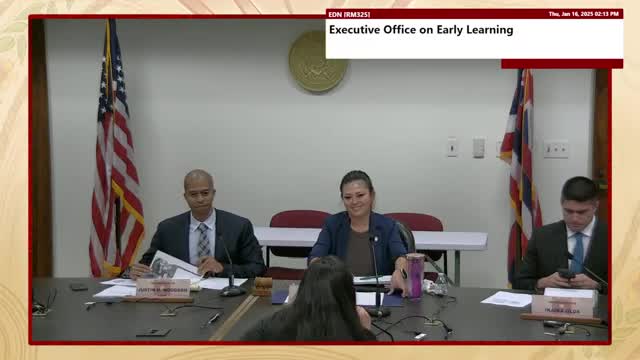
Summary
Yuko Arikawa Cross, director of the Executive Office on Early Learning, told the House Committee on Education that EOEL has expanded public pre-K seats, opened Hawaiian-language sites and is seeking funding to add 50 classrooms over two years, with staffing and coaching supports specified.
Executive Office on Early Learning Director Yuko Arikawa Cross told the House Committee on Education that EOEL is asking the Legislature for funding to open 50 new EOEL public pre‑K classrooms over the next two years and described recent growth in seats, outreach and workforce supports.
The request aims to add 50 teachers, 50 educational assistants and eight early learning state office teachers who would provide coaching and mentoring, Arikawa Cross said. EOEL plans those new classrooms as part of a broader effort to expand access to high‑quality early learning across Hawaii.
EOEL serves as the state's coordinating agency for early childhood and also administers the EOEL public pre‑K program, Arikawa Cross said. "What we strive for is that every child in Hawaii has access to high quality early childhood development and learning experiences, which lay the foundation for lifelong well‑being," she told the committee.
Since 2023 EOEL has opened 55 new EOEL public pre‑K classrooms, awarded about $260,000 in early‑childhood stipends and recorded progress on credential completers, Arikawa Cross said. EOEL now reports 92 classrooms on 74 campuses and has received more than 3,438 applications for the current school year. EOEL said it serves 3‑ and 4‑year‑olds in its public pre‑K sites.
Arikawa Cross outlined statutory priority categories EOEL uses when allocating seats: children served in their individualized education program in a general‑education setting, English learners, children in foster care, children experiencing unstable housing, and children from families with incomes at or below 300 percent of the federal poverty level. She noted that outreach and a streamlined online application increased identification of children experiencing unstable housing from about 11 when she started to 171 applicants this year.
EOEL highlighted new program work on Hawaiian‑language public pre‑K and family child interaction learning (FCIL) sites. The office said it opened its first Hawaiian‑language EOEL public pre‑K sites after convening community providers and charter schools to design culturally aligned programs. EOEL also funds FCIL sites; EOEL identified two initial community sites at Nanakuli Elementary School (Waiʻanae, Oʻahu) as program locations and said it is seeking additional host principals and campus space to expand the model.
On workforce supports, EOEL described an early‑childhood educator stipend program (about $260,000 awarded to roughly 103 participants to date and 18 stipend completers as of December) and accreditation and professional development partnerships with K‑12 and higher‑education institutions. Arikawa Cross said EOEL pairs each early‑learning state office teacher with up to six schools for coaching and mentoring; EOEL is requesting eight additional state office teachers to support the proposed 50‑classroom expansion. EOEL said coaches maintain monthly contact with classroom teams and conduct twice‑yearly class observations with debriefing.
EOEL also described work on fiscal mapping — a cross‑government inventory of state, federal and local funding for children up to age 24 — and said it expects mapping results to inform the office's updated state early childhood plan. In response to a committee question, Arikawa Cross said EOEL hopes to finish the revised state plan by the end of the year.
The presentation and committee discussion emphasized access (seats and wait lists), workforce pipeline and the program’s attention to priority populations. EOEL described outreach changes — simplifying the application and enabling online submissions from community devices — as a driver of higher application counts among families experiencing housing instability.
EOEL did not present a formal motion or vote; the agency requested funding and described operational details and outcome measures for the committee’s consideration.