Get Full Government Meeting Transcripts, Videos, & Alerts Forever!
Get email alerts on the House Bill 581 topic
No spam. Unsubscribe anytime.
Carroll County Board of Education holds public hearing on opting out of House Bill 581 homestead exemption
Summary
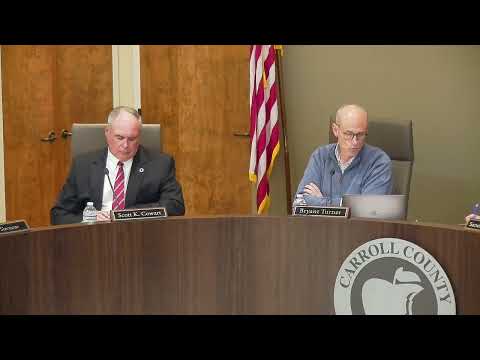
Carroll County Board of Education held a public hearing on Jan. 13, 2025, to gather community input on whether the district should opt out of House Bill 581, the Statewide Adjusted Base Year Ad Valorem Homestead Exemption enacted by the Georgia General Assembly.
Carroll County Board of Education held a public hearing on Jan. 13, 2025, to gather community input on whether the district should opt out of House Bill 581, the Statewide Adjusted Base Year Ad Valorem Homestead Exemption enacted by the Georgia General Assembly.
Board staff warned the exemption could reduce local school revenue over time, while citizens and former educators offered competing views about local control and state responsibility for school funding.
Assistant Superintendent for Business and Finance Delaine Wolf told the board that "House Bill 581 created a new exemption" called the Statewide Adjusted Base Year Ad Valorem Homestead Exemption and that the new exemption "stacks on top of" current homestead exemptions. She said the opt-out process applies only to the new exemption and that county assessments would continue to be done at fair value. Wolf summarized the district's analysis: had the exemption been in effect over the last five years, "the aggregate impact could be as much as $21,000,000 which would equate to over 200 teaching positions." She added that because state law caps millage adjustments tied to the state funding formula, the board could not fully offset that reduction by raising millage to the cap.
Superintendent Scott Cowart said the board has been studying House Bill 581 since August and reminded attendees that the opt-out decision would not change existing homestead exemptions and that senior homeowners who are already exempt from school taxes would remain exempt if the board opted out of the new exemption. He also highlighted the district's recent tax history: "we've had three consecutive years of millage rate cuts" and a 17% reduction in millage rates since 2016.
Board members scheduled two additional public hearings on the issue for Jan. 21 (noon and 6 p.m.), and board officials said they were continuing deliberations and had not reached a decision.
Public comment showed mixed views: - Bill Bennett, a Carroll County homeowner, urged the board not to opt out, saying the legislature and voters had signaled support for the change. "I definitely do not believe you should opt out," he said, and argued the state is moving away from a property-tax base toward consumption-based funding. - Bridal Hager urged the board to opt out, saying the state has a poor record of fully funding education and that the opt-out preserves local control. "I ask you to take the opt out this time," he said. - Jim Stevenson, a senior resident, opposed opting out and noted the district's current general fund budget and reserve: Wolf said the general fund for the fiscal year is $198,000,000 and the district's reserve target is roughly two months of payroll (about $25,000,000). Stevenson said the district also has the option to increase millage if needed. - Robert Pinkney, a former superintendent, recommended opting out, warning that reduced local revenue would limit the district's ability to maintain class sizes and services. - Norma Jean Kiddie and others noted that roughly 63% of local voters supported the state measure and opposed the board opting out. - Robert Graff said he supported opting out to preserve local flexibility, saying the statutory cap on millage increases "doesn't give them flexibility" and argued for local control.
Board member and others clarified related financing questions during the hearing. Assistant Superintendent Wolf and other staff explained that cities and counties were given a separate statutory mechanism to raise a 1% local sales tax in some cases, but school systems were not granted the same direct authority to raise a new sales tax for general operations; existing local sales taxes such as SPLOST (Special Purpose Local Option Sales Tax) are restricted to capital uses like facilities and buses and cannot be used for personnel or general operations.
No formal vote on opting out was taken during the hearing. The board adjourned the public hearing by voice vote at the meeting's close.
The district has two additional hearings Jan. 21 and will continue deliberations before making any formal decision about opting out of House Bill 581.