Get Full Government Meeting Transcripts, Videos, & Alerts Forever!
Get email alerts on the Stormwater topic
No spam. Unsubscribe anytime.
Consultant outlines Munhall stormwater obligations, suggests fee to fund pollution-reduction projects
Summary
LSSE presented the borough's MS4 inventory, pollution-reduction plan obligations and examples of stream-restoration projects, and described how a dedicated stormwater fee (measured in ERUs) could fund maintenance, capital work and PRP compliance.
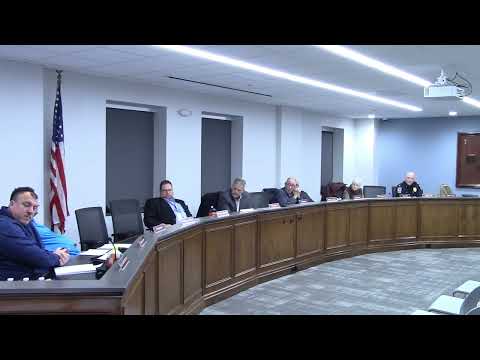
Munhall Borough Council heard a presentation Jan. 14 from John Belinsky of LSSE about the borough's stormwater system, its MS4 permit obligations and options for paying for long-term maintenance and pollution-reduction projects.
Belinsky, the LSSE representative, said the borough's separate storm system includes roughly 97,000 linear feet of storm sewer pipe, about 45 outfalls and about 900 structures, and that the borough's watershed is considered a combined area for permitting purposes. “You have about 97,000 linear feet of separate storm sewers,” he said.
The presentation explained the borough's MS4 permit requires annual reporting on six minimum control measures (public education, public involvement, illicit discharge detection and elimination, construction site runoff control, post-construction stormwater management and pollution-prevention/good housekeeping). Belinsky described a 2017 pollution-reduction plan (PRP) approved by the Pennsylvania Department of Environmental Protection to address stream erosion and sediment ("salication"/sedimentation) impairments in local tributaries. He said the PRP aimed to reduce sediment discharge roughly 10% and that earlier planning-level estimates for implementing PRP projects in similar municipalities were on the order of $5.5 million total (about $1.1 million per year over five years) though exact costs for Munhall were not yet set.
Because stormwater infrastructure lacks a dedicated revenue source, Belinsky described how other municipalities have adopted a stormwater utility fee based on impervious area, using an Equivalent Residential Unit (ERU) to measure average single-family impervious area (Belinsky said the sample average used in studies was about 2,000 square feet). Under that model, a commercial property with 10,000 square feet of impervious surface would be billed as five ERUs. He listed typical eligible uses for a stormwater fund: administration, capital improvements, operations and maintenance, and permit compliance and enforcement, and noted communities use a mix of fees and grants to meet PRP obligations.
Council members asked about compliance risk and timing. Belinsky said the borough files a progress report annually (due Sept. 30) and that DEP has extended current permits while it finalizes new permit language; he said DEP presentations suggest communities that have not completed PRPs could face consent orders but DEP had not issued a single enforcement formula to date. “Right now, we don't have an answer for that,” he said of specific enforcement steps.
Belinsky and council discussed operational details: how an ERU is calculated from samples of single-family lots, billing and exemptions for tax-exempt properties, and examples of other municipalities' rates (he cited a community that charges roughly $8 per month per ERU and collects about $1.1 million annually from a ~7,000 single-family base). He also described completed local projects LSSE has built to meet PRP goals as examples of stream restoration and detention/management facilities.
The presentation concluded with Belinsky's recommendation that the borough consider developing a business plan and fee structure if it wants a dedicated funding source for ongoing maintenance and PRP capital projects, while pursuing grant funding where available.
Council did not take a formal vote during the presentation; members asked for follow-up information, including a list of borough-owned storm assets, a clearer budget estimate for PRP projects tailored to Munhall, and guidance about how a fee would be implemented and administered.