Get Full Government Meeting Transcripts, Videos, & Alerts Forever!
Get email alerts on the Signs topic
No spam. Unsubscribe anytime.
Council hears proposal to update sign code to allow color electronic message boards and three-sided wall signs
Summary
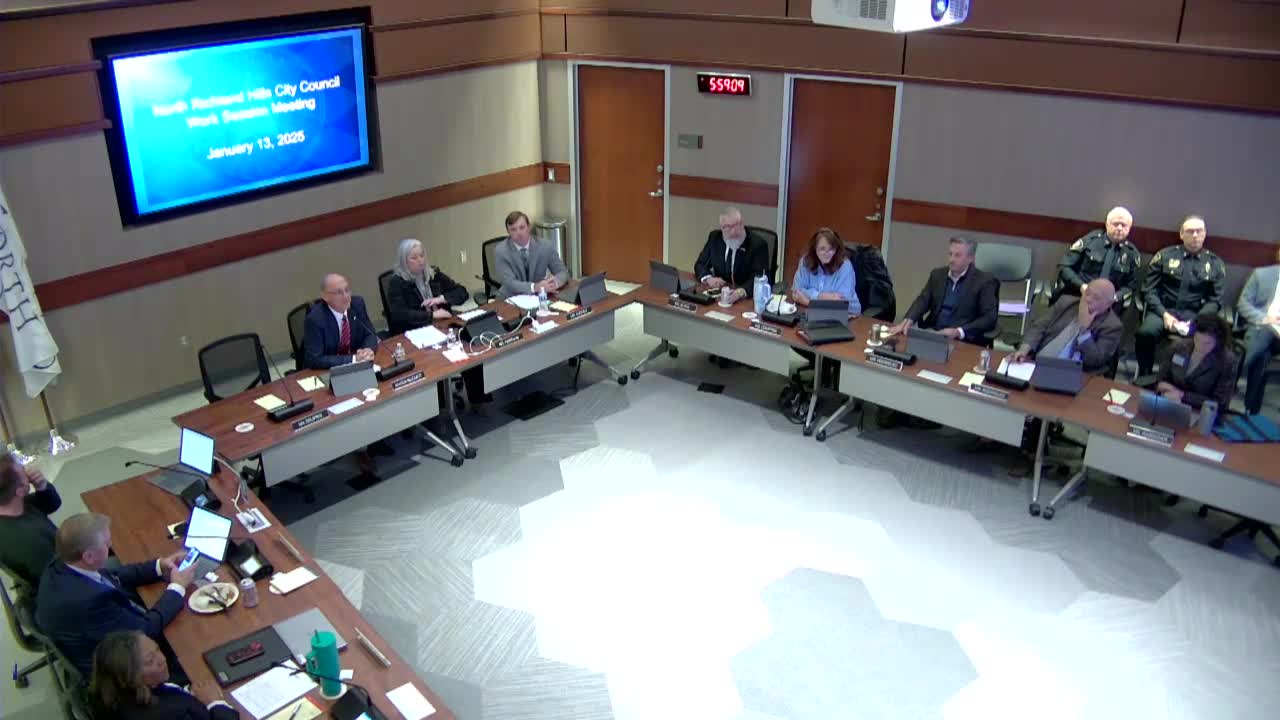
Clayton Comstock, a city planning staff presenter, told the City Council on Jan. 13 that staff will bring an ordinance to the council later this month to update Chapter 106 of the sign code to allow modern electronic message boards and to relax limits on wall signage.
Clayton Comstock, a city planning staff presenter, told the City Council on Jan. 13 that staff will bring an ordinance to the council later this month to update Chapter 106 of the sign code to allow modern electronic message boards and to relax limits on wall signage.
Comstock said the primary drivers for the proposed changes are requests from North Richland Hills-area public schools and houses of worship and the fact that current technology and the market have outpaced the city's standards. "Right now, our standards are antiquated at this point and we have technology that's surpassing the limitations of our current standards," Comstock said. He noted the current code limits reader boards to low-intensity amber lighting on a black background: "They have to be only amber with a black background."
Why it matters: staff said the proposed update is intended to allow schools and churches that are already allowed to locate in many zoning districts to use standard digital reader boards without having to rezone a property solely to get a sign. Staff identified Mulendor Elementary's reconstruction and recurring requests from churches as two immediate drivers for the change.
What staff proposed: Comstock outlined a set of technical and siting controls staff plans to include in the ordinance:
- Allow electronic message reader boards by land use (public and private schools, sole-use houses of worship, colleges/universities, parks, certain government buildings and outdoor amusement uses) rather than by zoning district. - Require static-image display of at least eight seconds per message and prohibit animation, scrolling or flashing text on the same sign face. - Require message transitions to occur instantaneously across the full face and automatic dimming tied to ambient light so night-time brightness is reduced. - Require automatic freeze/blank-screen capability when a sign malfunctions. - Limit electronic reader board message area to two-thirds of a monument sign face (staff said that preserves an identifying masonry surround) and require monument-style base for reader boards. - Require signs located wholly within or within 100 feet of single-family residential zoning or a single-family residence to be turned off between 10 p.m. and 6 a.m. (staff said the two-thirds monument allowance preserves a building's identity for schools and churches while protecting nearby residences).
Comstock also said staff wants to align local standards with TxDOT and digital-billboard practices on brightness and message timing and to require automatic dimming so signs do not exceed a small increment above ambient light.
Wall signage: staff also asked the council for feedback on raising the limit on wall signs from two building facades to three. Comstock said the city's current measurement of maximum sign area uses "habitable wall area" (an interior-derived dimension) and that measurement is uncommon and confusing for sign contractors; staff recommended simplifying the metric and allowing more flexibility on number of facades to reduce the need for variances. Several council members said the community's experiences with digital signs and modern wall treatments over the last decade have reduced the initial safety concerns behind the original rule.
Next steps: Comstock said staff will return with a draft ordinance for the council's Jan. 27 meeting. He also said the staff prepared an inventory map of existing schools and churches and their existing sign conditions to share with the council.
Ending: Councilmembers asked questions about resident adjacency, enforcement of brightness standards, and how the rule would treat multi-tenant commercial properties versus single-use church sites. No formal vote was taken at the Jan. 13 meeting; staff will return with a proposed ordinance on Jan. 27.