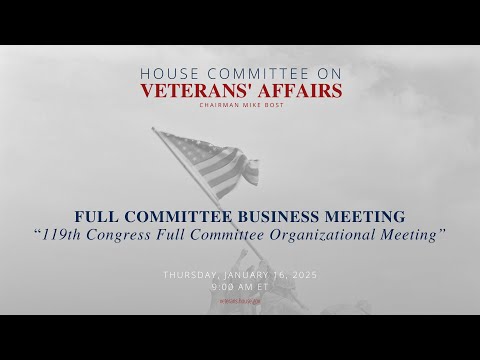
Veterans Affairs committee adopts rules requiring disclosure of funding tied to foreign adversaries; 10%-budget amendment rejected
Get AI-powered insights, summaries, and transcripts
SubscribeSummary
At its organizational meeting, the House Committee on Veterans' Affairs adopted a rules package that adds new disclosure requirements for witnesses who receive funding from entities associated with foreign adversaries or countries of concern, including grants tied to TikTok, Chairman Mike Bost said.
The changes to the committee rules also authorize electronic voting when possible and update the committee's truth-in-testimony disclosure practices. Ranking Member Mark Takano offered an amendment that would have required witnesses to disclose any single funding source amounting to more than 10% of their organization’s operating budget; the committee voted the amendment down.
Chairman Mike Bost, who opened the meeting, framed the rules change as a response to concerns about foreign influence in veteran-related testimony. "We as Congress had enough of a concern about the TikTok ban," Bost said, adding that the committee updated its rules to "require the witness to disclose funding that comes from entities associated with foreign adversaries such as TikTok." He described the committee as bipartisan and said he was committed to using the panel to serve veterans.
Ranking Member Mark Takano described his amendment as a transparency measure that would require witnesses to disclose contributions that exceed 10% of an organization’s operating budget over the prior fiscal year. "The goal here is to increase transparency into the circumstances that may influence the organizations that we rely on to inform our policy making," Takano said, urging support for the broader disclosure standard while saying the measure was not intended to target veterans service organizations.
Representative Mariannette Miller-Meeks questioned whether the committee should also require disclosure of funding coming primarily from government sources, arguing that such funding could create different incentives. "Why wouldn't we also then require, if we would require this, that any organization, nonprofit who presents before us, if the primary source of their funding is from the government, why wouldn't we want to know that also?" Miller-Meeks asked.
Members debated whether the 10% threshold would create an undue burden on witnesses or deter testimony. Chairman Bost and other supporters emphasized that the rules change adopted by the committee targets funding from entities and countries identified as potential adversaries and that the truth-in-testimony process already captures federal grants and contracts.
Votes at a glance
- Takano amendment (require disclosure of any single funding source >10% of an organization’s operating budget): motion offered by Ranking Member Mark Takano; defeated by voice vote (nays sustained). Tallies were not specified in the transcript.
- Committee rules package (includes electronic voting authorization and disclosure requirements for funding from entities associated with foreign adversaries and countries of concern): motion to adopt offered and approved by voice vote. (Chairman Mike Bost moved adoption; voice vote.)
- Resolution designating vice chair and subcommittee chairs: approved by voice vote (vice chair: Miss Radewagen; subcommittee chairs and assignments listed in committee packet). Motion to adopt moved by General Burkeman/Birkman.
- Resolution designating ranking minority members of subcommittees and majority members of subcommittees: approved by voice votes (motions moved by Ranking Member Mark Takano and others as noted in the record).
- Resolution approving committee staff: approved by voice vote (moved by Ranking Member Mark Takano).
- Committee authorization and oversight plan for the 119th Congress: approved by voice vote; the plan was described by the chairman as a comprehensive strategy to oversee VA care and benefits.
All of the resolutions listed above were approved by voice votes; the transcript does not provide roll-call tallies.
Context and next steps
Committee members also used the organizational meeting to welcome returning and new members and to express condolences for recent wildfires in Southern California. The record shows members may submit technical and conforming amendments and have five legislative days to revise or extend remarks on the organizational meeting. Ranking Member Takano gave notice of intent to file minority supplemental or dissenting views on the committee authorization and oversight plan.
The committee did not adopt the Takano 10%-threshold amendment but did incorporate a disclosure requirement aimed at funding linked to foreign adversaries and at the request of the minority added disclosure for funding associated with countries identified by the U.S. State Department as "countries of concern." The rules change is procedural and will govern how non-governmental witnesses report potentially influential funding when they testify before the committee going forward.
Ending
With the adopted rules and leadership assignments in place, the committee moved on to its oversight responsibilities for the coming Congress; members and staff were authorized to make technical and conforming changes to the adopted documents within the specified amendment and remarks period.