
Mesquite outlines pavement assessment, prioritizes neighborhood rehabilitation and preventive maintenance
Get AI-powered insights, summaries, and transcripts
Subscribe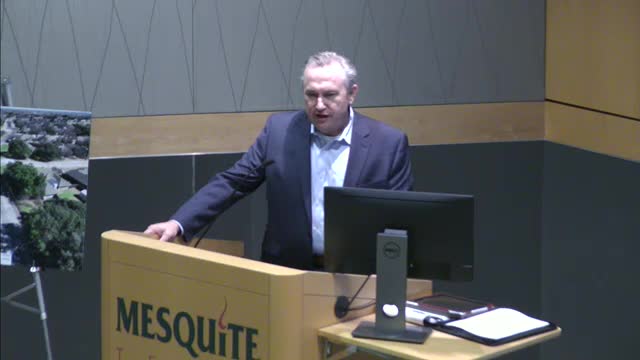
Summary
City staff presented results of a 2024 pavement assessment, described major and neighborhood projects including South Parkway and FP Lucas, and answered resident questions about drainage, driveway access during construction and traffic enforcement. No formal votes were taken.
Mesquite city officials on the first town-hall Tuesday of 2025 presented findings from a citywide pavement assessment completed in late 2024 and described near-term and longer-term street projects, funding partnerships and maintenance strategies.
The presentation laid out why some streets need full reconstruction while others can be extended through preventive maintenance, and officials said the city will prioritize neighborhoods and high‑volume collector streets rather than fixing single blocks in isolation.
The pavement assessment, finished in late fall 2024 with a final report delivered the last week of December, evaluated every road in the municipal network — major arterials, local streets and alleys — and produced a pavement-condition-index (PCI) score for each segment on a 0–100 scale. "We had a company go out and evaluate every single road within our network," said Eric Alt, director of public works.
Why it matters: the assessment lets the city target limited funds to the worst roads and to neighborhood clusters, officials said. City staff and council members repeatedly emphasized that full replacements are costly and that preventive maintenance (crack sealing, shoulder work, seal coating and better pothole patches) can extend pavement life for many years.
Details and projects: staff cited several active and planned projects. The South Parkway resurfacing and channel work were discussed repeatedly: officials said paving work on South Parkway is nearly complete and that a separate South Mesquite Creek channel project (to replace culverts and stabilize slopes) has been preliminarily studied but requires additional funding before it can be built. "Right now that's going to be a question of getting funding. That's a potential project on the 5 year CIP," said John Mayer, city engineer.
FP Lucas (also discussed as "Lucas") is under construction and includes concrete slip‑form paving, a roundabout and trails in a fast‑growing area; staff and council discussed staging and that much of the underground work should finish before final paving occurs. Project cost figures were discussed in the meeting and differed in remarks: one speaker referred to Lucas as a "$30,000,000" project while another said the stretch came in at about "$25,000,000." The city staff acknowledged the large cost and said full street replacements are expensive.
Lawson Road, LaPrada/La Bridal (cited with a PCI of about 23), Military Parkway and Whitson Way were all raised by residents. Staff said Lawson design submittals are expected in spring 2025 with about 18 months of design before construction; LaPrada will be designed and bid later in the year with construction expected to span multiple years. Staff said Military Parkway is on their short‑term patching list and that Whitson Way will be evaluated for short‑term repairs and longer rehabilitation.
Maintenance approach and potholes: officials described two common pothole repairs and said the city will put more emphasis on higher‑quality patches. "When we do potholing, we're going to do a little bit better — square off the pothole, clean it, put in a tack coat and use a hot mix — you'll get a lot longer life," Alt said. Staff said some pothole cold patches (the quick fill often sold at hardware stores) last only a few months, while properly done patches can last one to two years.
Access and construction impacts: residents on FP Lucas raised concerns about driveway access, deep ruts and contractor traffic leaving mud on private driveways. Officials said contractors are required to maintain access to driveways, provide an all‑weather temporary surface (for example a flex base or temporary asphalt), and that city inspectors will press contractors to keep access passable. Staff acknowledged weather and heavy construction traffic make this difficult and advised residents to use provided city and contractor contacts for urgent problems.
Traffic safety and enforcement: several residents reported speeding and drivers running stop signs (for example at Sybil Drive and South Parkway). The city said it will relay enforcement requests to the Mesquite Police Department and will evaluate engineering changes to improve visibility and slow traffic (roundabouts and additional stops were mentioned). Councilman B.W. Smith, District 5, said funding remains constrained but reiterated an emphasis on making repairs last: "Every year, we allocate $1,000,000 of dollars for road, street, and alley repair," Smith said.
Funding and context: staff said the city looks for alternative funds — federal grants, county and state partnerships — and noted some projects use a roughly 50/50 split with Dallas County. Staff and council members also reminded the public that a 2015 street bond approved by voters (discussed in the meeting as $125,000,000 at the time) and inflation since then changed the scope of what those funds could accomplish.
Public reporting: staff encouraged residents to report potholes and traffic concerns through the My Mesquite app so items feed directly into city work orders; they asked reporters to provide specific location details so crews can find and address problems more efficiently.
No formal council vote or formal action was taken at the town hall; the event functioned as a public briefing and question‑and‑answer session. City staff and council members stayed after the presentation to speak to residents individually and invited people to the next town hall on March 11, 2025.
Ending: City officials said they will use the pavement‑assessment data to guide a hybrid, neighborhood‑focused paving program that balances efficiency, high‑volume streets and coordination with utility work to avoid tearing up newly paved streets.