Get Full Government Meeting Transcripts, Videos, & Alerts Forever!
Get email alerts on the Animal Control topic
No spam. Unsubscribe anytime.
Lake Bluff committee reviews broad overhaul of animal-control code; draft sent to Village Board
Summary
The Committee of the Whole heard a presentation on a comprehensive update to Lake Bluff’s animal-control code, including new definitions, a structured dangerous-animal process, expanded enforcement options for police and consolidated rabies provisions. Staff will bring a revised ordinance to the Village Board for first reading in two weeks.
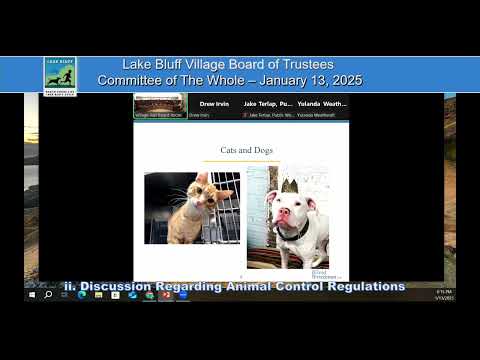
Kelly Ganderski, a partner with LRAD Friedman, presented a draft comprehensive amendment to Lake Bluff’s animal-control code to the Committee of the Whole on Jan. 13, saying the village’s current provisions date from 1974 and “there was a little bit of work to do.” Ganderski summarized proposed changes intended to give police clearer, enforceable options for dealing with dangerous and nuisance animals and to bring the village code into alignment with state rabies requirements.
Why it matters: The draft creates a single, structured investigatory and decision process for incidents such as dog-on-human and dog-on-dog bites, clarifies definitions (dangerous, provoked, at large), consolidates rabies provisions, and expands alternatives short of impoundment or euthanasia so police can keep animals and people safer while giving owners defined pathways to retain animals.
The draft adds a detailed definition section and a multi-step investigatory process that directs officers to interview witnesses, collect reports and produce a record supporting any dangerous-animal finding. Under the proposal, euthanasia would be required only if an animal causes a human death; it may be ordered for severe injury. Other options for animals declared dangerous include confinement in a home or enclosure, a secure muzzle while leashed (maximum 6-foot leash length specified), posted warning signs on the property, implanting a microchip, mandatory sterilization, completion of obedience training, and a liability insurance requirement of not less than $100,000. The draft also preserves the village’s existing authority to ban a dangerous animal from village limits.
On rabies, the ordinance consolidates scattered rabies language and adopts the state-mandated observation/holding practice commonly called a 1-in-10 or 10-day hold: if the animal is current on rabies vaccinations it is observed by a veterinarian at home and rechecked on day 10; if not vaccinated, the animal must be held at a veterinary facility for observation. The draft also clarifies owners’ responsibilities to report and confine animals that have bitten someone.
The draft creates flexible leash-and-recall language that would allow off-leash activity where a dog reliably responds to voice recall and would allow owners to keep cats outdoors if they are collared with a bell. For impounded animals the proposal specifies holding periods: animals with identifying tags will be held up to seven days; unidentified animals will be held three days; cats of unknown ownership may be immediately transferred to a rescue partner.
Ganderski said the code changes were tailored to Lake Bluff’s scale and resources — unlike a large municipal shelter system. She cited the village police department’s data packet, which shows calls for service over the past five years have been under 60 annually and that only five animals were declared nuisance or dangerous over that period, but noted bite reports increased in 2024.
Committee members asked about the appeal process for a dangerous-animal designation and where appeals should be heard. The draft preserves the chief’s order while an appeal is pending; euthanasia is the one exception where the process differs (a dog would not be euthanized while an appeal is pending unless the full appeal process had been completed). Staff and trustees discussed whether appeals should be heard administratively or by the board. Village Administrator Drew (referred to in the meeting by his first name) and several trustees favored an administrative appeal to the village administrator rather than bringing emotionally charged cases before the full board; that approach was described as a faster, less politicized hearing limited to reviewing whether the chief’s investigation and report supported the finding.
The draft includes new enforcement tools for cruelty and neglect, a consolidated penalties chart, standards for grooming and boarding facilities (inspection authority for complaints), and a provision allowing officers to remove animals from life-endangering vehicles after reasonable notice. The draft also includes a proposed prohibition on possession of pigeons and construction of pigeon coops in residential districts (Lake Bluff Code section 5-9B-24); the Committee expressed consensus to keep that provision in the draft for now and revisit it later if needed.
Action and next steps: Committee members and staff agreed the ordinance needed additional refinements but directed staff to place the revised draft on the Village Board agenda for first reading in two weeks. No formal roll-call vote on the ordinance occurred at the Committee meeting; the item was advanced for Board consideration by consensus.
The Committee also approved the meeting minutes for the Sept. 23, 2024 Committee of the Whole meeting earlier in the session by voice vote.
A number of implementation details remain to be finalized in the ordinance packet to be supplied to the Village Board, including the precise appeal hearing procedure (administrative officer vs. a panel), the text of consolidated penalties, and cross-references to other village codes (for example, zoning rules that could affect backyard livestock).