
Vermont BGS commissioner outlines operations, energy programs and workforce challenges to Senate Institutions Committee
Get AI-powered insights, summaries, and transcripts
Sign Up Free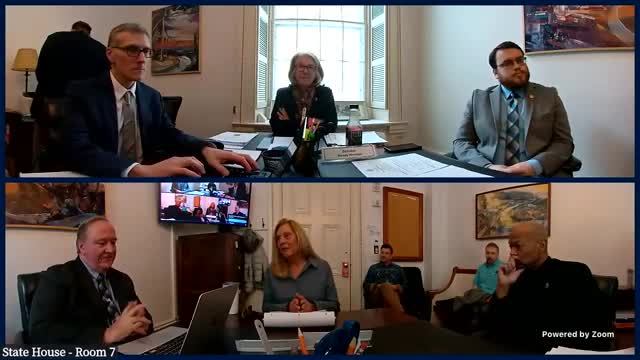
Summary
Commissioner Wanda Manoli and senior staff from the Department of Buildings and General Services (BGS) briefed the Senate Committee on Institutions on Jan. 16 on BGS’s structure, procurement practices, energy and resilience grants, facility leasing and workforce recruitment efforts.
Commissioner Wanda Manoli, commissioner of Buildings and General Services, told the Senate Committee on Institutions on Thursday that she views the committee as “my committee of jurisdiction” and outlined BGS’s responsibilities, staffing and recent programs. "My name is Wanda Manoli. I am the commissioner of buildings and general services. I started this role on October 14, 2024," she said.
The presentation gave committee members an overview of BGS’s divisions — operations and maintenance, design and construction, planning and property management, purchasing and contracting, safety and security, government business services, state curator — and highlighted several current priorities: energy resilience and implementation grants to municipalities, procurement preferences for Vermont vendors, development of workforce pipelines through paid internships, and outstanding reports due to the legislature. The briefing combined high-level metrics with examples of day-to-day work, such as building maintenance, leasing for agencies and managing state-owned collections.
Manoli framed BGS as a service agency for state government and Vermont businesses and stressed cross-agency partnerships. She said BGS has “over 300 employees” and manages about “3,000,000 square feet” of space. John Hebert, director of operations and maintenance, described that operations staff account for roughly 215 employees and handle routine custodial, electrical and HVAC work across six districts. "I've been with BGS for 22 and a half years," Hebert said.
Commissioner Manoli summarized BGS’s energy work and grant activity. She said that in 2022 about $45,000,000 in "ARCO funds" was appropriated for energy investments and that implementation grants reached 126 municipalities and covered more than 250 projects; she described the program as administered through BGS’s energy and resilience efforts. Eric Kemberg, director of planning and property management, said his division handles real estate transactions for state agencies and currently manages 94 leases; BGS leases roughly 866,000 square feet for state use.
On procurement, Manoli reviewed the role of the Office of Purchasing and Contract (OPC). The OPC, she said, administers contracting rules (including contracting bulletin 3.5) and currently oversees about 1,358 active contracts, with 48% held by Vermont vendors; she stated 53% of contracts are available to cities and towns. Committee members asked about the statutory preference for resident or Vermont vendors; Manoli and her staff said preference is given where “all other considerations being equal,” with additional evaluation criteria for responsiveness and responsibility.
Workforce was a recurring theme. Manoli and Hebert described a paid internship program with high school technical centers: six internship positions exist, but only one was filled at the time of the briefing; that intern later became a full-time hire. Hebert described outreach through technical center co-op directors and said internships typically run two to four days a week.
Manoli also noted several reports requested by the legislature that remained in process: an update on the naming of state facilities, a study tied to the Windsor property in coordination with the Agency of Natural Resources and Fish & Wildlife, and a status/plan update for correctional facilities (including a women's reentry facility site proposal). She said BGS had requested extensions to coordinate with other agencies and planned to present updates to the committee at a future meeting.
The presentation included brief descriptions of other BGS programs: safety and security operations (threat mitigation, emergency procedures and building access), government business services (visitor centers and information operations in partnership with other agencies), the fleet program, the state print shop and state surplus auctions, and the state curator’s role advising the Capital Complex Commission on historic preservation and art programs.
The committee scheduled follow-up time for more detailed reports and said members would review the requested extension paperwork and the language of outstanding reports. No formal votes or committee actions were taken during the briefing.