Get Full Government Meeting Transcripts, Videos, & Alerts Forever!
Get email alerts on the Wildfire Insurance Pool topic
No spam. Unsubscribe anytime.
Committee introduces wildfire insurance RS proposing mitigation grants and market stabilization tools
Summary
RS 31831, presented by the Department of Insurance, would create a board and a mitigation/stabilization pool funded by premium‑tax growth, residual stamping fees, a small cigarette‑tax balance and other sources to help homeowners harden properties and stabilize the homeowners insurance market; the committee introduced the RS after extensive Q&A.
The House Business Committee on Wednesday introduced RS 31831, a Department of Insurance‑backed initiative to address rising homeowners insurance costs tied to wildfires and a tightening market.
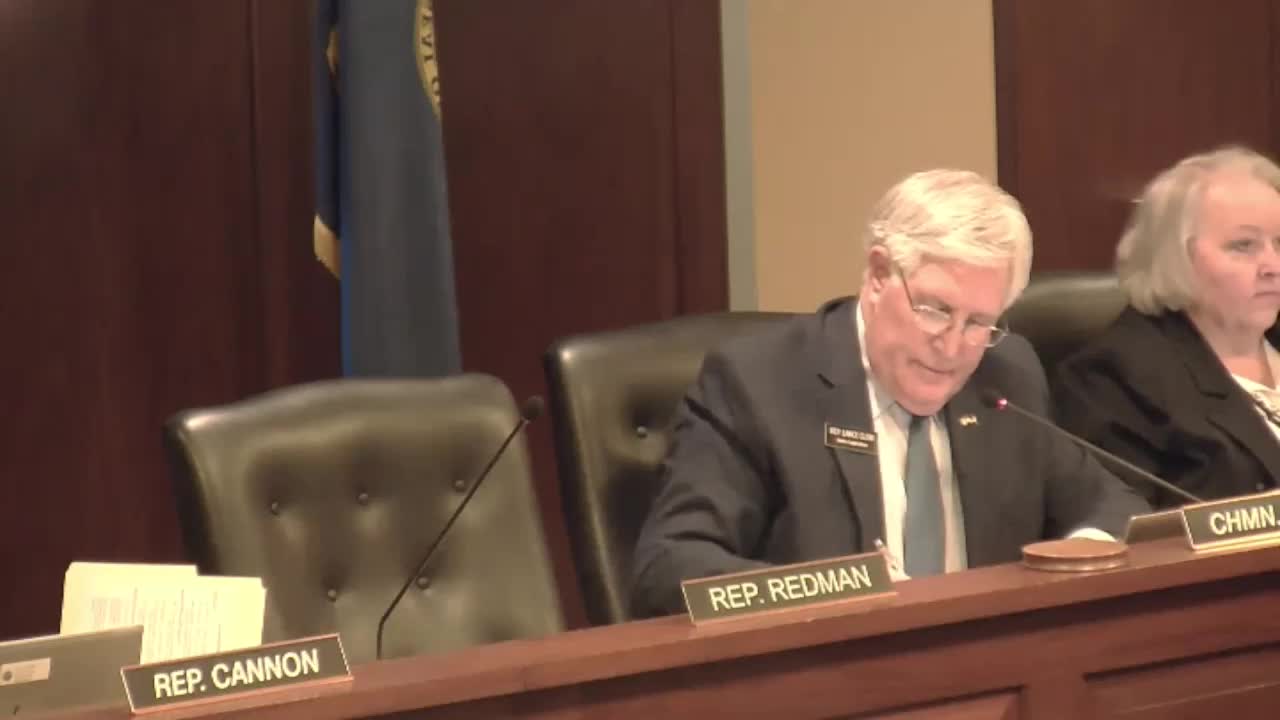
Dean Cameron, director of the Idaho Department of Insurance, summarized the RS, saying Idaho had a severe wildfire year and the insurance market is contracting in many Western states. “We started working on this a couple of years ago when we started seeing the insurance market tightening up,” Cameron said. He told the committee Idaho “burned nearly 1,000,000 acres of wildfires” during the most recent season and that communities saw property loss: “we lost significant numbers of property … 140 some structures … 41 of them were residences,” language Cameron used in his presentation.
Cameron described two principal strategies in the RS. The first is a mitigation grant program to help homeowners harden properties — examples given included screening eaves, modifying landscaping, or replacing roofs — modeled in part on hurricane‑era mitigation pools in southeastern states that used one‑time grants to lower rates. The second creates an industry‑driven stabilization board that would evaluate market mechanisms such as deductible buy‑downs or other insurer‑supported programs; the board would be industry‑led with nonvoting state seats (including the State Fire Marshal and a nonvoting executive from the Department of Insurance), Cameron said.
The RS identifies several funding sources: (1) a diversion of one‑quarter of future growth in premium‑tax receipts above a historical baseline; (2) a small cigarette‑tax allocation that the Department said has historically been minimal (roughly $35,000–$135,000 in recent years); (3) excess surplus‑lines stamping fees collected by the Surplus Lines Association; and (4–6) potential industry contributions or assessments to backboard stabilization mechanisms if required. Cameron said the proposal is designed so board contracting and administrative costs would be paid from the pool — not the general fund.
Committee members sought specifics. Representative Harris pressed whether the RS would have a negative fiscal impact; Cameron responded that contracting costs would be covered by the pool and described how statutory mechanics would divert premium‑tax growth and regulate assessments to prevent overspending. Representative Birch asked for projections on total dollars needed, how awards would be allocated, whether means testing would apply and how to balance state support for owners building in higher‑risk areas; Cameron and committee members agreed those operational questions would be detailed if the RS becomes a bill.
Representative Muntz moved to introduce RS 31831. The motion passed; the transcript shows three recorded no votes when members asked to be recorded on the record: Representatives Harris, Marmon and Razor were entered as voting no. The RS will return as a bill for stakeholder input, drafting and detailed fiscal and implementation review.