Get Full Government Meeting Transcripts, Videos, & Alerts Forever!
Get email alerts on the Public Safety Fire Administration topic
No spam. Unsubscribe anytime.
Nampa, fire district workshop focuses on impact-fee agreements, station deeds and options for fire administration space
Summary
City and Nampa Fire Protection District officials reviewed impact-fee IGAs, a long-term airport lease for Station 5, corrected deeds for Station 2 and several options to resolve the district’s administrative-building needs.
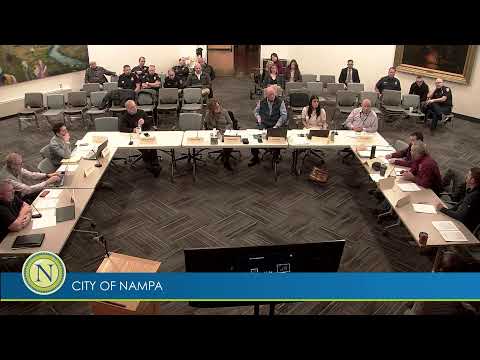
City officials and Nampa Fire Protection District leaders met in a collaborative workshop to review multiple outstanding items from the 2020–2021 annexation and to discuss options for the fire district’s administrative space.
Chief Kirk Carpenter (referred to in the meeting as Chief Carpenter) summarized completed items and ones that remain open. He said the district has worked with the county to update intergovernmental agreements (IGAs) for development-impact fees but needs the city to sign updated documents removing the City of Nampa from county-level administration language. He said city legal review is in progress and staff hope to complete the city-side IGA updates within weeks.
Carpenter said the district and airport staff are negotiating a long-term lease for Station 5 land (currently a year-to-year arrangement) and that the airport has proposed two 10-year leases with escalation clauses. The district reported interest in purchasing the site in the long run, but noted Federal Aviation Administration (FAA) rules may allow the airport to reclaim land in some circumstances; a long-term lease would secure operations in the near term.
On Station 2, Carpenter said a record-of-survey completed by the district identified an unintended transfer of roughly 20 acres at annexation; staff corrected the record and returned about 18.5 acres (park and athletic fields) to the city while retaining approximately 1.5 acres for the station. Deeds reflecting the corrected parcels were prepared and filed.
The most substantial discussion focused on the district’s administrative and training-space needs. Carpenter said the district moved out of the purpose-built public safety building when police needed that space; the district then occupied a downtown building and later relocated to a facility on 9th Street South. Carpenter said the district has outgrown the interim administrative space after adding finance and human-resources functions previously provided by the city, and that the administration-building issue remains one of the last outstanding annexation items. He described three general options discussed in the workshop: 1) transfer ownership of the downtown building to the fire district (City to make the district "whole" either by deed or equivalent value), 2) add a line item to police impact fees to compensate the district for the administrative-space relocation (staff and legal advised on statutory limits), or 3) pursue no change now and retain the current property arrangement.
Mayor and councilmembers emphasized the city’s duty to act with integrity and suggested the city should make the district "whole" if an obligation exists. The mayor recommended establishing a market valuation for the downtown building — a broker assessment or independent appraisals — and noted the council might decide to retain the downtown building for future city needs but should ensure the district is compensated if the building is retained. Council members asked for legal confirmation whether state impact-fee statute allows correcting an error within five years; staff said they had initial guidance from the consulting firm (TischlerBise) that corrections within five years can be eligible but agreed to obtain formal legal confirmation.
Several councilmembers also proposed running parallel analyses: (1) a legal review with the impact-fee consultant and city legal to confirm whether police impact fees can be amended to address the prior space transfer, and (2) a broker assessment of the downtown building and a valuation of the square footage historically used by the fire department in the public-safety building (council discussion pointed at a consultant estimate used earlier that assigned a $2.1 million figure to the fire department’s prior square footage). Carpenter said a negotiated trade (transfer of the downtown building in exchange for a discounted or credited purchase of another building the district is evaluating) was on the table in prior conversations but no final agreement was in place.
Other technical clarifications in the workshop: the district’s 2024 capital-improvement plan (CIP) shows reduced impact-fee obligations for certain land uses (for example lower fees for storage facilities because of lower service use) and increases for industrial uses; the district participates in the county DFAC process and the city’s DFAC members volunteered to serve on the district’s DFAC. Carpenter noted the district has already paid for the Station 2 record-of-survey work and that deeds returning park acreage to the city were executed.
The workshop ended with council direction to pursue parallel paths: legal verification about any allowable impact-fee correction (and the calculation method/eligible timeframe), and a broker assessment or appraisal to determine the downtown building’s market value and the appropriate square-footage valuation that would make the district whole. Staff said they would return with legal confirmation and valuation estimates for council consideration. No formal council vote on a transfer or compensation occurred at the workshop.