Get Full Government Meeting Transcripts, Videos, & Alerts Forever!
Get email alerts on the State Eviction Legislation topic
No spam. Unsubscribe anytime.
Manchester Housing Commission to ask mayor to oppose House Bill 60, citing local housing strain
Summary
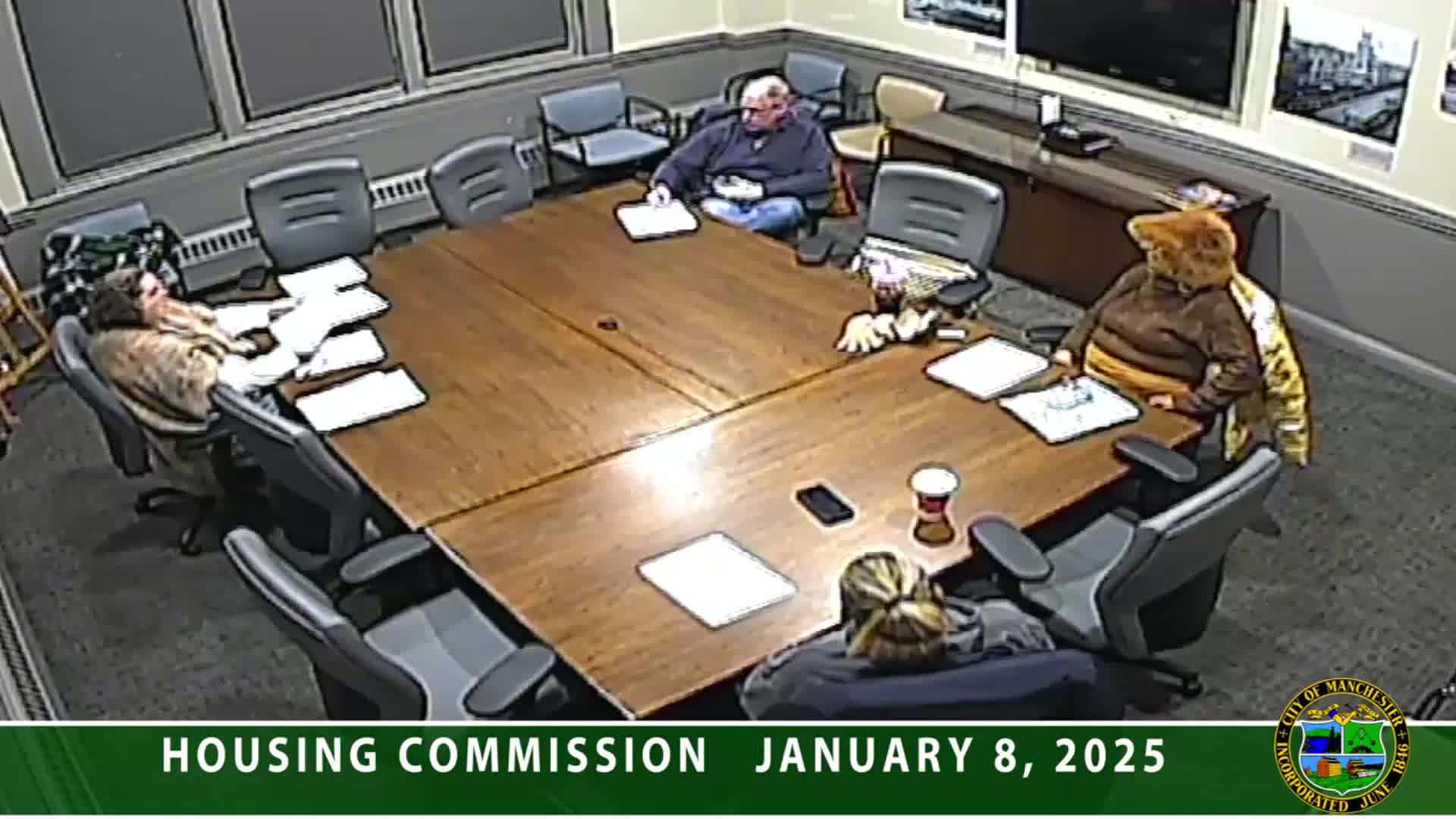
The Manchester Housing Commission on Jan. 8 agreed to draft a letter asking the mayor to raise concerns with Manchester’s state legislators about House Bill 60, saying the bill as written could increase evictions and worsen local housing instability.
The Manchester Housing Commission on Jan. 8 agreed to draft a letter asking Mayor and Board of Mayor and Aldermen leadership to raise concerns about House Bill 60 with the city’s state legislators, saying the bill as written could add to tenant instability in Manchester.
The commission described HB 60 as legislation that would make the expiration of a lease or tenancy (if the tenancy had lasted more than six months) a ground for eviction. Commissioners said the change would reduce tenant protections after a lease expires, shorten the practical time tenants have to find new housing and increase uncertainty in an already tight market.
Members framed the action as a request for the mayor to discuss the bill during his meetings with Manchester legislators and the Manchester caucus. Commissioners agreed one member would draft a proposed letter and circulate it to the commission for review before sending it to the mayor’s office.
Why it matters: Commissioners said Manchester’s rental market and support services are already stressed. They said shortening protections at lease expiration could result in more eviction filings, more burden on local rehousing services and higher housing instability for renter households and vulnerable populations. The commission discussed coordinating a broader advocacy effort that could include community organizations and landlords.
Key details from the meeting - Legislation discussed: House Bill 60 (referred to in the meeting as “House Bill 60”), described by commissioners as making lease expiration (for tenancies longer than six months) a standalone ground for eviction. The commission discussed the practical effect of 30–60 day notices and court timelines on rehousing prospects. - Local advocacy plan: The commission resolved to draft and circulate a letter asking the mayor to raise Manchester-specific concerns with the city’s state legislators and the Manchester caucus. A member volunteered to draft the letter for commission review and possible signature. - Broader outreach: Commissioners discussed the value of coordinating with other organizations, including landlord groups and statewide housing advocates, and cited Housing Action New Hampshire’s legislative tracker as a resource to follow bill progress. - Related local context discussed during the meeting: commissioners reviewed recent municipal housing data and development activity (see clarifying details), expressed concern about proposed zoning changes and a four- to six-story, ~50-unit market-rate proposal near the city’s Gaslight District, and noted that the Manchester Continuum of Care had updated the PIT (point-in-time) count methodology, producing higher counts that commissioners said more accurately reflect local homelessness.
What commissioners said and decided (process clarity) - Discussion only: Commissioners debated the policy trade-offs between tenant protections and landlord rights, the appropriate notice period if the bill moves forward, and whether a compromise (longer notice or delayed implementation) would be preferable to immediate passage. - Direction/assignment: Commissioners agreed to have a member draft a letter to the mayor asking him to discuss HB 60 during his meetings with Manchester legislators and requested the draft be circulated to the commission for comment. - Formal action: The meeting concluded with a motion to adjourn that the commission approved by voice vote.
Local data and capacity notes discussed Commissioners said municipal data collection on new units and affordability has softened: they reported a recent summary (attributed to Planning/Community Development) listing 543 certificates of occupancy issued in the prior year, roughly 600 new dwelling units, and 707 units in active construction. They said the city designated about $1.65 million in federal funds for the Pearl Street lot project and that proceeds from surplus land sales (reported in the meeting as approximately $1.13 million) had been placed into the Affordable Housing Trust Fund; commissioners noted $200,000 from those funds was used to create eight affordable units expected to open this month. Commissioners also said a more detailed AMI (area median income) breakdown was not available in the materials they had seen and requested written documentation from Planning staff.
Homelessness count: Commissioners discussed the most recent PIT count for Manchester and New Hampshire. They said counts rose compared with prior years largely because the methodology was expanded (counting over multiple days and using additional intake points), and that the larger count likely reflects more-complete counting rather than a sudden spike in unhoused persons. The Manchester Continuum of Care’s next meeting was announced for Jan. 16 at 9 a.m. at the Manchester Health Department and via Zoom (Manchester-dash-coc.org was cited).
Zoning/character concerns: Commissioners discussed a zoning board application expected to request a variance for a proposed ~50-unit market-rate building near the Gaslight District (near Murphy’s/Gaslight Diner). Several commissioners voiced concerns about preserving the district’s character and urged community input to the planning and zoning process, noting that proposed zoning overlays (expanding Heritage Commission review) could change approval pathways.
Next steps and timeline: The commission will circulate a draft letter to the mayor for review. Commissioners said they will monitor HB 60’s movement through the legislature (judicial committee and later floor votes were discussed) and consider broader coalition outreach if warranted. The Board of Mayor and Aldermen agenda postings around Jan. 21–February were identified as probable next municipal milestones for commission status and any formal requests to the mayor’s office.
Ending: The commission closed its January meeting after adopting the adjournment motion and will reconvene if reappointed and if municipal scheduling permits.