County planner outlines Tier 2 rezoning near Parowan after 2023 septic study
Loading...
Summary
Iron County planner Reed Erickson presented proposed changes to county Tier 2 boundaries and zoning around Parowan, citing a 2023 Utah Geological Survey septic density study and urging coordination with the city on annexation, sewer interconnection and future growth.
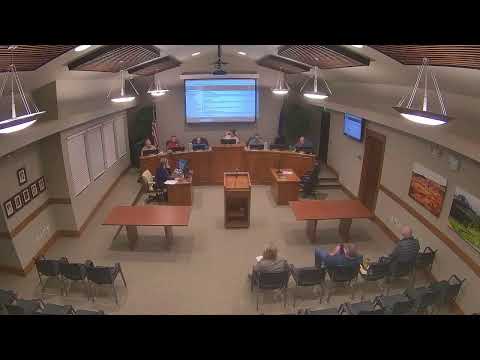
Reed Erickson, the county planner, told the Parowan Planning and Zoning Commission on Jan. 15 that Iron County is proposing to shrink the Tier 2 urban-expansion boundary around Parowan and to change county zoning in the area in response to a 2023 septic-tank density study by the Utah Geological Survey.
The change matters because the county’s 1995 tiering policy and the 1980s zoning that followed have left large swaths of land zoned for half-acre lots even where groundwater and septic capacity make higher densities inappropriate, Erickson said. "We recently in the county did a septic tank density analysis, which was a study done by the Utah Geological Survey in 2023," he said. "So regardless of what the zoning was, the minimum lot size was 5 acres around Parowan and Paragonah. And that's been the case for about a year."
Erickson told commissioners the county’s goals are to coordinate land-use rules with municipalities so development that requires sewer and central water occurs where services can be provided, and to discourage piecemeal, septic-dependent subdivisions that later complicate annexation and service delivery. He said the 2023 study found different minimum lot-size recommendations across basins: in some nearby study areas the county will require 10-acre minimums for new septic-served lots, while around Parowan the study concluded 5 acres per septic could be appropriate because of greater groundwater mixing and existing sewer treatment capacity that reduces the number of septic systems.
County staff showed maps that would reduce the Tier 2 boundary around Parowan, follow property lines, and rezone much of the long-standing R1-half (half-acre) county zoning to R5 or RA20 in areas that would be outside the revised Tier 2. "We would just change all of that to R5, because that's the minimum they can be for a septic," Erickson said. Under the proposal, land outside the dark-blue dotted Tier 2 line would be limited to 20-acre lots in Tier 4, and land inside Tier 2 but not connected to sewer would generally be limited to five-acre minimums for septic.
Erickson and commission members discussed sewer interconnection agreements, county plans to redesign or expand regional wastewater facilities, and the county’s interest in working on a countywide sewer district. "The ultimate goal and the recommendation from the Utah Geological Survey is to work towards sewer, central sewer, sewer treatment for Kanarraville and Summit and Newcastle and Paragonah," Erickson said. He told commissioners the county will require property within 300 feet of an available sewer trunk line to hook into the system only if interconnection agreements and capacity exist.
Commissioners asked about commercial and industrial uses near highway interchanges; Erickson said commercial and light industrial parcels would be handled separately and existing industrial lots would remain zoned for their current uses. He also said some Tier 2 boundaries were expanded around other municipalities but would be reduced near Parowan to reflect a realistic 20-year growth window.
Next steps: Erickson said the county planning commission will review the proposals again at its Feb. 6 meeting and the county commission is scheduled to consider the amendments on Feb. 10. He invited Parowan staff and commissioners to send written feedback and offered to provide detailed maps by email.
Why this matters: The proposed changes affect where higher-density residential subdivisions can be built, whether new development will be septic-dependent or served by municipal sewer, and the long-term pattern of annexation and service delivery around Parowan. County officials cited groundwater nitrate risk from high concentrations of septic systems as a principal driver for the proposed changes to tier boundaries and minimum lot sizes.