Get Full Government Meeting Transcripts, Videos, & Alerts Forever!
Get email alerts on the Land Use Zoning topic
No spam. Unsubscribe anytime.
Lancaster Council, consultants review UDO Module 2; members ask for page-by-page walkthrough
Summary
County council heard a module-by-module review of the Unified Development Ordinance (Module 2) covering landscaping, parking, lighting, signs and building design. Council members pressed consultants and staff for simpler geographic standards, stronger tree-save requirements and a page-by-page review before finalizing the code.
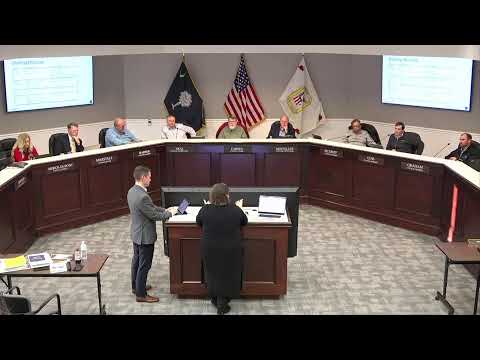
Lancaster County Council, meeting as the Committee of the Whole, on Feb. 1 reviewed Module 2 of a proposed Unified Development Ordinance update with consultants from White & Smith and county planning staff. The module covers development and design standards including landscaping, parking, outdoor lighting, signs and architectural design.
The session produced clear direction from several council members that the draft should be simplified and reviewed in detail before final adoption. Council members repeatedly asked for a page-by-page walkthrough, and discussion centered on two competing approaches for dividing the county into development-area standards: a three-part geographic map aligned with the comprehensive plan and a map based on existing zoning districts.
Kelly Cousineau, a White & Smith consultant, and Sean Scopmeyer of White & Smith described the module and the project schedule. Cousineau said the UDO update was broken into modules to make review manageable and that Module 2 aligns with chapters on development standards. Scopmeyer reviewed proposed changes to landscaping and open-space rules, including a new mandatory tree‑save approach and larger buffers around certain uses. He said the draft would require most developments with existing trees on site to preserve a percentage of the site’s tree canopy, generally between 10% and 30%.
Council members raised multiple concerns about unintended consequences for existing businesses and redevelopment along highway corridors. Council member Harper urged detailed, line‑by‑line review: “We have got to get into page by page, front to back,” he said, arguing that requirements such as parking and buffer rules could prevent redevelopment if applied without exceptions. Several council members, including Charlene McGriff and Brian Mosteller, voiced a preference for a simpler geographic approach tied to the county’s three development areas (Panhandle, Greater Lancaster and Southern Lancaster). Mosteller suggested U.S. 522 as a potential dividing line for eastern county character.
Planning staff and consultants said the process is iterative: drafts go to staff and a planning commission subcommittee for review, then back to council and the public before a consolidated final draft. Allison Hardin, county planning staff, said the team intends to return to council in March to begin review of administration and procedures and that a final consolidated draft is targeted for staff review in the fall. Hardin noted the consultants and staff are using subcommittee meetings and public outreach to test provisions as the drafting proceeds, and urged council to continue providing feedback during the modular review process.
The consultants described several substantive provisions in Module 2: a move away from district‑based buffer triggers toward clearer perimeter buffer standards; increased parking‑lot landscaping; a proposed streetscape buffer for commercial corridors and major subdivisions; and open‑space standards that exclude counting unusable areas such as steep slopes or wetlands toward required park or common area. Scopmeyer said the draft does not protect individual “specimen” trees but instead focuses on preserving tree canopy across sites, and that buffer areas may be counted toward required tree‑save percentages.
Council members and staff discussed implementation details and next steps. Several members requested an additional meeting, or a series of short, topic‑focused meetings, to walk through the first pages of the draft in detail. Planning staff said the planning commission subcommittee meets weekly and that sessions are recorded; staff suggested the council could form a small subcommittee to meet with planning commissioners and staff if the council wished to follow the same conversations closely.
No ordinances or zoning changes were adopted at the meeting. The only formal vote recorded on the transcript was approval of the meeting agenda earlier in the session; substantive decisions about Module 2 were limited to direction to continue review and to schedule further meetings. Council members requested that staff and consultants return with additional materials that map proposed development areas and show examples of how new standards would apply to typical development scenarios.
The county’s UDO update has proceeded in modules: module 1 addressed zoning districts and uses, module 2 covers development and design standards and the next scheduled module is administration and procedures. Counsel and staff emphasized they will present a consolidated draft after public and staff comments are incorporated, and that council will have additional opportunities to review the complete document before formal readings.
Ending: Council members said they want to avoid unintended consequences and asked staff and consultants to show concrete examples of how the new standards would affect redevelopment and existing properties. Staff agreed to schedule additional review sessions and to return with a consolidated schedule and materials ahead of the March review of administration and procedures.