Get Full Government Meeting Transcripts, Videos, & Alerts Forever!
Get email alerts on the Postsecondary Education & Workforce topic
No spam. Unsubscribe anytime.
Committee hears respiratory care interstate compact to speed licensure mobility for therapists
Summary
House Bill 1114 would enact the Respiratory Care Interstate Compact to permit qualified respiratory therapists to obtain multistate authorization to practice in member states; witnesses — including hospitals, professional associations and the Department of Defense — said the compact would improve patient access and address workforce shortages.
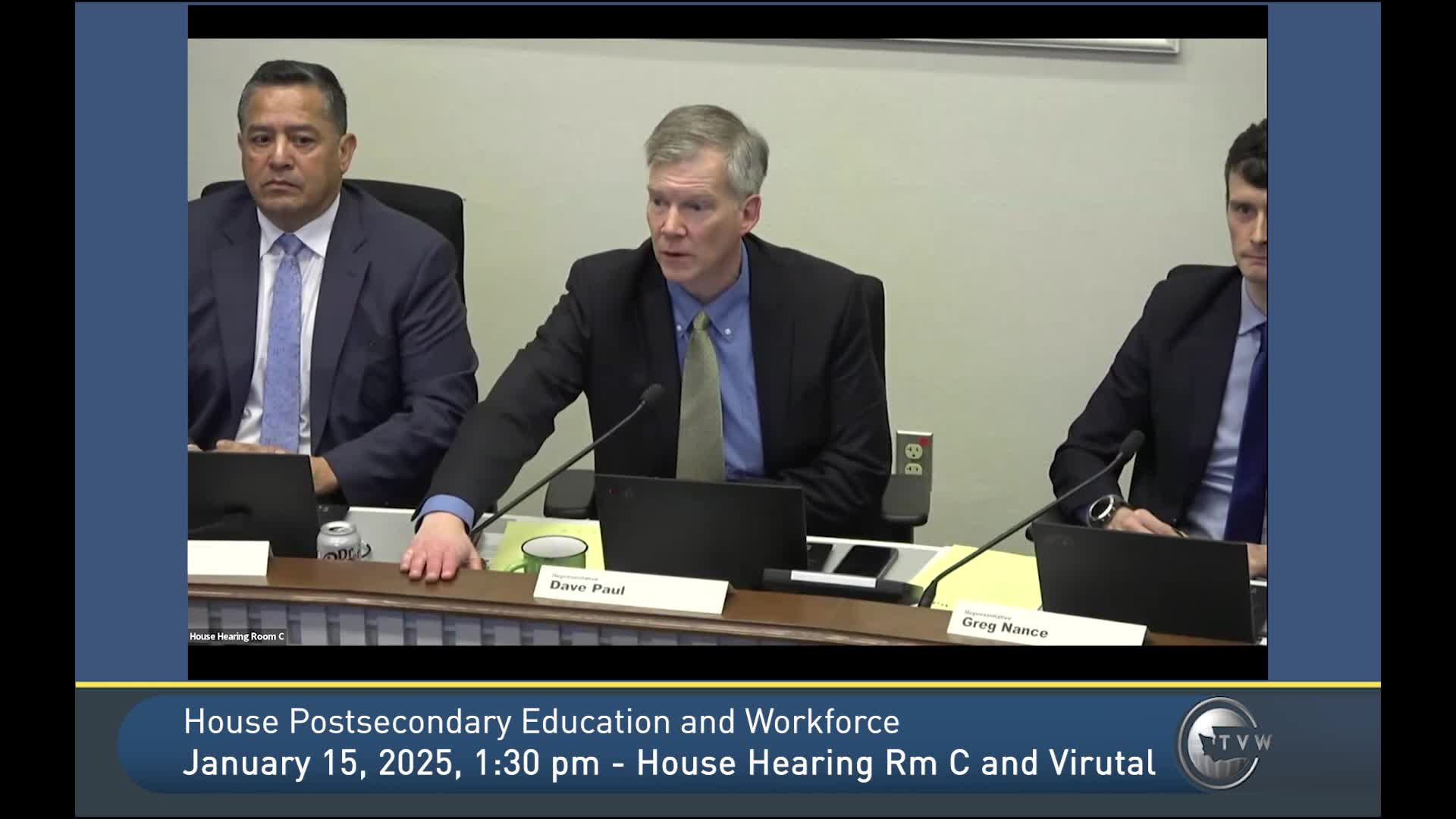
The House Postsecondary Education & Workforce Committee held a hearing on House Bill 1114 to enact the Respiratory Care Interstate Compact (RCIC), a multistate agreement intended to allow licensed respiratory care practitioners to practice across member states using a compact privilege.
Committee staff described the RCIC’s core elements: member states must license respiratory care practitioners and meet compact requirements, practitioners must hold a qualifying home-state license and national credential, complete background checks, and meet jurisprudence requirements (familiarity with a remote state’s laws) to receive multistate practice privileges. The compact would be administered by a Compact Commission and becomes effective once the number of enacting states specified in the model compact is reached (commonly seven).
Why it matters: Proponents, including hospital systems, professional associations and the Department of Defense, said the compact would increase workforce flexibility, improve access to respiratory care during crises and help military spouses and service members maintain workforce continuity when they relocate.
Key testimony - Sponsor: Representative Marie (pronunciation as stated) said the compact addresses workforce shortages and supports military families. She emphasized the compact’s public-safety benefits: shared information among states improves oversight and enables state-level action when a practitioner violates rules. - Department of Defense: Tammy Perrault said compacts are a preferred pathway for military families and noted compact provisions that allow active-duty service members and spouses to designate a home state to preserve licensure continuity. - Professional associations: Miriam O'Day of the American Association for Respiratory Care said the profession has a single national credentialing body with consistent educational standards that support interstate portability. The Association of Washington Business and the Respiratory Care Society of Washington also testified in support. - Provider systems: John Moyer, director of respiratory care at MultiCare Health System, and Carl Hinkson, senior director of ancillary services at Providence, testified that Washington faces a shortage of respiratory therapists and that the compact would reduce administrative barriers to bring practitioners into patient care quickly.
Questions and implementation issues - Several members asked how many states have enacted or introduced the compact; witnesses said the model compact was finalized recently and that states are beginning to consider implementing legislation. - Staff and witnesses discussed the compact’s disciplinary mechanism: member states may take action against a practitioner’s compact privilege within their borders, while only the home state may directly revoke an underlying license.
Ending: The committee recorded extensive proponent testimony and noted there were a number of non-testifiers in support. No formal committee vote occurred during the hearing; staff discussed next steps and amendment deadlines for executive action.