Get Full Government Meeting Transcripts, Videos, & Alerts Forever!
Get email alerts on the Public Safety Fire Ev Safety topic
No spam. Unsubscribe anytime.
Chaffee County Fire Protection District reports rising calls, warns of EV fire water needs; launches community CPR classes
Summary
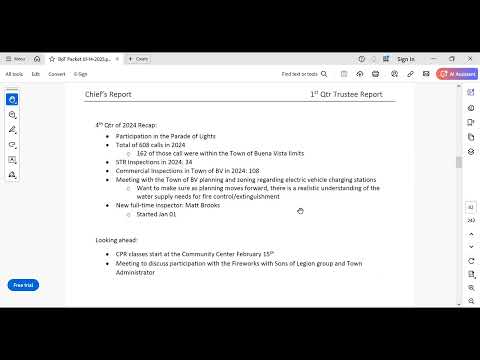
Chaffee County Fire Protection District representatives told the Town of Buena Vista Board of Trustees on Jan. 14 that the district handled 608 calls in 2024 and is seeing an increase in incidents inside town limits.
Chaffee County Fire Protection District representatives told the Town of Buena Vista Board of Trustees on Jan. 14 that the district handled 608 calls in 2024 and is seeing an increase in incidents inside town limits.
"We had 608 calls in 2024," the Chaffee County Fire Protection District representative said, adding that about "162 of them were within the town of Buena Vista." The presenter stressed the district is not the community's primary medical responder: "We don't run medical. We're not primary medical."
The district also summarized inspection work: 34 short‑term rental (STR) inspections were completed between August and the end of December 2024, and 108 commercial inspections were recorded for Buena Vista in 2024. Staffing changed over the year; the district said it lost an inspector in April and operated with a single inspector for much of 2024. A new inspector, Matt Brooks, started Jan. 1 and has already been participating in STR inspections.
Trustees were told of several community programs and coordination efforts. The district is planning a meeting with town staff and event organizers about July 4 fireworks, and it will offer a community CPR class starting Feb. 15; the class will be held monthly and the instructor fee is $35 to cover materials and a two‑year certification.
District staff raised a public‑safety planning issue tied to electric vehicles (EVs). "We're talking at least 30,000 gallons for one vehicle," the presenter said when describing the water demand for extinguishing or cooling EV battery fires. The presenter described EV fires as an extended, slow process focused on cooling batteries to prevent chain reactions rather than a short, easily extinguished blaze: "It's at least over the course of an hour, maybe more. It's a very long extended process... the intent is not to extinguish the flames; the intent is to cool the batteries down."
On mitigation tools, the district noted it carries two EV blankets — one stationed at each end of the district — to smother fires and remove oxygen, but emphasized the downstream problem of where to store or isolate a damaged EV after a fire. The presenter also described how clusters of charging stations can pose risk if a battery fire spreads between vehicles and said some large charging installations pair with on‑site battery systems to maintain capacity, which raises additional code and exposure considerations.
Trustees asked whether proximity of fire hydrants matters for charging stations. The district replied that current fire code does not yet require hydrants specifically for EV charging points, but added, "The closer hydrants is, the better it is," and encouraged trustees and planning staff to account for potential water‑demand needs when reviewing proposals for large chargers.
The fire district recommended that when the town evaluates large charging stations it consider the district's water‑supply commitment and potential infrastructure implications; the district said it will continue coordinating with planning staff on future proposals.
Trustees did not take formal action on the presentation; the session ended with staff and trustees thanking the presenter and noting follow‑up coordination would continue.