Get Full Government Meeting Transcripts, Videos, & Alerts Forever!
Get email alerts on the Climate Energy topic
No spam. Unsubscribe anytime.
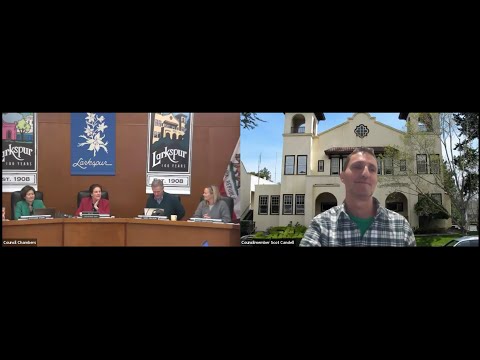
Larkspur council weighs new climate engagement model after presentations from Marin Clean Energy and regional partners
Summary
Marin Clean Energy and the Marin Climate & Energy Partnership briefed the Larkspur City Council on local programs, then council directed staff to stand up a bi‑monthly liaison forum to improve community engagement on the city’s Climate Action Plan.
Marin Clean Energy and the Marin Climate and Energy Partnership briefed the Larkspur City Council on Tuesday about clean‑energy programs, rebates and countywide planning, and council members directed staff to set up a new community liaison process to accelerate local implementation of the city’s Climate Action Plan.
The presentations opened with Sebastian Khan, a senior community development manager at Marin Clean Energy (MCE), describing MCE’s role supplying generation and customer programs across four Bay Area counties. “MCE has been around now for 15 years,” Khan said, and he highlighted MCE offerings for residents and municipalities including income‑qualified electric‑vehicle rebates, a program to help drivers charge at times when the grid is cleaner, and workplace and multifamily EV charging support. Khan told the council Larkspur’s current participation rate in MCE is 83.8 percent.
The countywide partnership that supports municipal climate work, the Marin Climate and Energy Partnership (MCEP), also presented. Christine O’Rourke, MCEP sustainability coordinator, reviewed regional tools available to cities — greenhouse‑gas inventories, an EV acceleration strategy, a building electrification roadmap and model ordinances — and the status of Larkspur’s 2021 Climate Action Plan. “Electricity emissions are down 84 percent since 2005,” O’Rourke said, but she noted transportation remains the largest emissions sector and stressed the need to electrify vehicles and building heating.
Nut graf: Why this matters — Larkspur leaders said they want clearer, more regular local tracking and public communication about how the city is implementing measures to meet state greenhouse‑gas reduction goals. Council members and staff emphasized the city needs better ways to surface near‑term actions (for example, building electrification and EV charging) and to bring community expertise into policy work without burdening limited staff resources.
Council discussion focused on how the city should increase public engagement and accountability for the Climate Action Plan. Assistant City Manager Shannon O’Hare presented three engagement models staff researched: a council‑liaison forum (San Rafael uses a similar approach), periodic public workshops, or a formal sustainability advisory committee. Council members, staff and several public speakers argued for a structure that (a) fosters substantive, technical input from engaged residents, (b) avoids procedural obstacles that can slow collaboration, and (c) is realistic given Larkspur’s small staff.
After discussion the council settled on a liaison forum model as the initial approach. Council members directed staff to establish a standing forum that will meet every other month and to provide a short written update to the full council in the intervening months. Staff will identify a single staff liaison (the council asked that the city’s MCEP representative be the staff contact) and will begin outreach to community participants who have been active on climate issues.
The council did not adopt a formal ordinance at the meeting; rather, members asked staff to return with a proposed schedule, staff assignment and a simple operating plan. “I think we’re gonna do bi‑monthly, and then in between, do a council update,” one council member said during the decision.
Key details and follow up: The council asked staff to include a clearer annual status report tied to the city’s greenhouse‑gas inventory cycle, to create a public‑facing one‑page dashboard of progress on Climate Action Plan tasks, and to consider a small capital line in the city’s CIP to track sustainability investments. Staff also committed to tracking the staff time required to run the new forum so the council can assess ongoing resource needs.
Ending: Council members said they want the new liaison forum up and running quickly because a number of regionwide initiatives and potential local code changes (for example, reach code options to encourage electrification) are on a short timeline. Staff will return with a draft structure and calendar to a future city council meeting for formal adoption.