Get Full Government Meeting Transcripts, Videos, & Alerts Forever!
Get email alerts on the Climate And Environment topic
No spam. Unsubscribe anytime.
Environment Board urges CARP as comp‑plan backbone, calls for measurable goals and tree‑canopy action
Summary
The Environment Board urged the Land Use Commission to adopt the city’s Climate Action and Resilience Plan (CARP) as the foundation for the comp plan’s environment chapter and to embed measurable mitigation and resilience goals across the entire document.
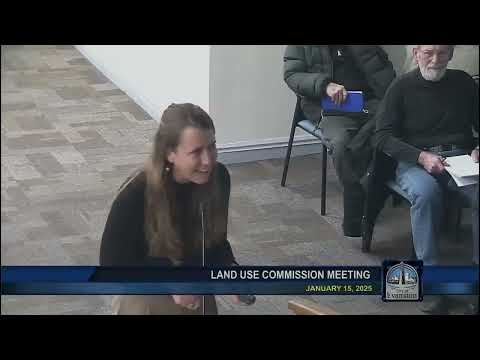
Katarina Topalov, member of the Environment Board and chair of the city’s CARP Implementation Task Force, told the Land Use Commission that Envision Evanston must adopt the Climate Action and Resilience Plan (CARP) as a foundational element and bake mitigation, resilience and environmental equity into each chapter.
Topalov summarized climate trends relevant to Evanston: she said regional average temperatures have already increased about 1.5°F and cited climate projections of a 7–12°F rise by century’s end. She highlighted stormwater and intense two‑inch precipitation events as an increasing risk to Lake Michigan shoreline communities and urged that flood‑resilience measures be added to the plan.
Key recommendations from the Environment Board presentation included: - Use CARP as the basis for the environment chapter and weave measurable mitigation and resilience goals into all chapters, not only a single environment section. - Set quantifiable, trackable goals and publish a public climate dashboard to show progress and projections. - Focus on tree canopy and green infrastructure: maps in the board’s materials show heat‑island correlations with lower canopy and historically redlined areas; the board recommended native plants and nature‑based solutions that improve stormwater absorption and habitat. - Advance deconstruction policies and circular‑economy approaches for building materials to reduce embodied carbon. - Continue with the city’s energy and healthy buildings efforts and align the comp plan with implemented climate actions (for example, the recent DOE grant and the Healthy Buildings Ordinance work).
Why it matters: The Environment Board framed climate adaptation and environmental equity as cross‑cutting matters that change how other policies (housing, land use, transportation, parks) should be designed. Commissioners asked for clarifications about cost and who would pay for interventions; Topalov pointed to grant opportunities and existing city programs (e.g., green‑homes weatherization) as partial funding sources.
Ending: The commission asked staff to consider the board’s specific suggestions for measurable goals and inclusion of CARP recommendations in the comp plan’s next draft.