Get Full Government Meeting Transcripts, Videos, & Alerts Forever!
Get email alerts on the Tax Increment Financing topic
No spam. Unsubscribe anytime.
Marathon County committee debates changes to TIF law, urges clearer Joint Review Board practices
Summary
Members of the Marathon County Executive Committee discussed proposed changes to state tax-increment financing (TIF) rules, focusing on Joint Review Board composition, notice timelines, reporting, third-party review and possible allocation for affordable housing.
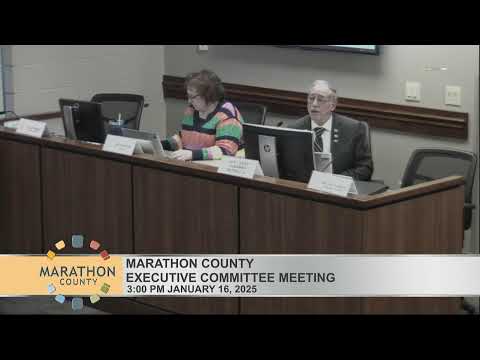
Marathon County Executive Committee members discussed potential changes to state tax-increment financing (TIF) law and local practices during a committee meeting, focusing on Joint Review Board composition, timing of information provided to reviewers and the public, and reporting requirements.
The discussion, prompted by task force recommendations and a draft resolution circulated by Pete Weinschek, centered on whether the Joint Review Board has the right mix of members and information to set or extend a TIF’s life. Committee members also debated whether municipalities should provide TIF plan documents earlier and in a more accessible form so board members and the public can perform meaningful review.
The matter matters because TIF districts shift tax revenue streams among overlapping taxing jurisdictions and can affect Marathon County’s levy. Committee members noted that the county already has dozens of active TIFs and that delayed or opaque information can limit scrutiny by other taxing jurisdictions and residents.
Committee discussion and key points
Chair (unnamed) opened the agenda item noting the packet included task force materials and a draft resolution from Pete Weinschek. "We're looking at item number 7 a discussion of the tax incremental financing legislation changes based on the task force recommendations," the chair said.
Supervisor Robinson framed the committee’s likely role as addressing state statutes and county advocacy and listed issues for review: the Joint Review Board’s composition, the extension process and timeline standards, notice requirements, and donor-versus-recipient TIFs. Robinson urged using the Department of Revenue guidance and task force questions as an educational baseline for the county’s position.
Supervisor Mirage said she was "in favor of adding an additional citizen member and an additional county board member" to the Joint Review Board. Other supervisors cautioned that adding seats can prompt calls for more seats from other taxing jurisdictions and could expand a board from five to many more members.
Multiple supervisors argued for improving the timing and accessibility of TIF materials. Supervisor Frederick recommended modernizing notice practices beyond publishing legal notices in newspapers and suggested requiring that plan documents be available in a single, accessible location well before Joint Review Board meetings; he also recommended third-party financial review and cited the City of Wausau’s use of Ehlers for an independent "but-for" analysis.
Committee members discussed a minimum advance period for plan availability. Doctor Robinson cited existing Department of Revenue (DOR) guidance referencing a 45-day timeframe and several participants urged a practical minimum of 30 days for Joint Review Board members and the public to review materials prior to a final decision. The chair said he would contact the Wisconsin Counties Association (WCA) to seek whether there is legislative appetite for changes before the committee pursues advocacy.
Reporting and monitoring TIFs
Supervisors noted Marathon County has roughly 40 active tax increment districts and that, as reported in the discussion, the county’s portion of levy tied to TIFs exceeds $5,000,000. Supervisor Robinson recommended producing a simple annual summary for the County Board containing core data (creation date, expiration/expected close date, current valuation, extensions), information that is largely available from the Department of Revenue website.
Affordable housing, Act 12 and incentives
The committee discussed a proposed change to allow municipalities to extend a TIF for affordable housing beyond the current one-year allowance; participants said legislation may be introduced to permit two- or three-year extensions. Opinions differed: some members viewed the change as an expanded use of TIF money, others argued for incentives to close districts early.
Members also discussed a recent statutory change, cited by a committee member as Act 12 of 2023, that creates a levy-limit adjustment for TIDs created in 2025: an initial one-time adjustment equal to 10% of newly created value and an increase to 25% where a district closes before 75% of its anticipated life. The committee noted that this incentive applies to newly created districts and not automatically to existing TIDs.
Direction and next steps
By consensus the committee pushed for clearer timelines and better public access to TIF materials (a working target discussed was 30 days prior to final decisions), and the chair said he would reach out to the Wisconsin Counties Association to assess legislative interest before pursuing advocacy. The committee asked the county’s Joint Review Board representative to provide an annual summary of TIFs to the County Board.
Ending
No formal motion on statewide legislative language was taken at this meeting. Committee members asked staff to compile suggested language and to coordinate with the Economic and Educational Development Committee (EEDC) and WCA as appropriate.