Get Full Government Meeting Transcripts, Videos, & Alerts Forever!
Get email alerts on the Public Safety Budget topic
No spam. Unsubscribe anytime.
Winneshiek County sheriff outlines steady budget, warns of social-services reimbursement uncertainty
Summary
Sheriff Dan Larson presented the sheriff's office budget, saying most line items remain level while staffing and potential changes in county social-service reimbursements pose risks to operations.
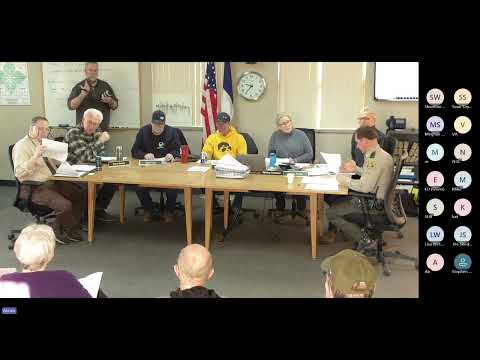
Sheriff Dan Larson told the Winneshiek County Board of Supervisors on Jan. 14 that his office’s proposed budget for fiscal 2026 is largely unchanged from the prior year but faces pressures from staffing and possible cuts to social-services reimbursements.
Larson, appearing at the supervisors meeting to review his department’s budget, said payroll and benefits account for the major pressures but that most non-payroll items remain flat. “The budget’s tight this year,” Larson said. He told supervisors the office has kept expenses down and historically returns unspent appropriations to the general fund, estimating the county has returned roughly $200,000 on average per year and “a little over $2,000,000 over the last 10 years.”
Why it matters: Larson said the sheriff’s office counts on that built-in margin to avoid emergency amendments later in the fiscal year and urged continued flexibility because some public-safety costs are unpredictable. He also warned supervisors about a funding change that could have a sizable effect on the county budget: reworking of how county social services pay for mental-health and transport costs.
Larson said some community mental-health transports and costs tied to involuntary hospitalizations (sometimes referred to in the meeting as committals) are currently covered by county social services. “We don’t know what the future of that will be,” he said, adding that his understanding is the funding might be reduced or moved, and that would “have a significant serious impact on budget.” Marked uncertainty about whether the state or a new contractor will continue those reimbursements was a repeated theme.
On staffing, Larson said the department is confronting retirements and vacancies: two deputy openings and ongoing difficulty recruiting and retaining jail positions. He said the office currently has “five experienced certified applicants for two jobs” for deputies, but jailer recruitment remains “a tale of two cities.” He cited state staffing rules that affect male/female staff ratios in the jail and that those rules complicate hiring and scheduling.
Larson pointed to a long-run cost advantage from hiring certified deputies rather than sending new hires to the academy, saying it has been “close to 50 years” since the office had to send many new deputies to a full academy, noting the training-plus-salary cost for academy training can exceed $50,000 per hire by statewide averages cited in the meeting.
Larson also described the county’s reimbursement calculation for a shared program (referenced in the packet as an ADU program with Gilmer/Auditor language). He said the county receives about $60,000 a year for that program, calculated as 50% of a top-paid deputy’s pay and benefit package prorated to 1,040 hours (about 20 hours per week).
Board reaction and next steps: Supervisors acknowledged the constraints and thanked Larson for the office’s efforts to hold the line on costs. No formal vote was taken on the sheriff’s budget at the meeting; the item was presented as part of the departments’ budget review cycle.
Ending: Larson reiterated the department’s reliance on contingency in budgeting and asked supervisors and residents to be aware of how legislative or social-services funding shifts could increase county burdens. “You can’t amend the budget in June without chance of it getting denied,” he said, summarizing why some cushion remains in departmental requests.