Get Full Government Meeting Transcripts, Videos, & Alerts Forever!
Get email alerts on the Criminal Justice Acjc topic
No spam. Unsubscribe anytime.
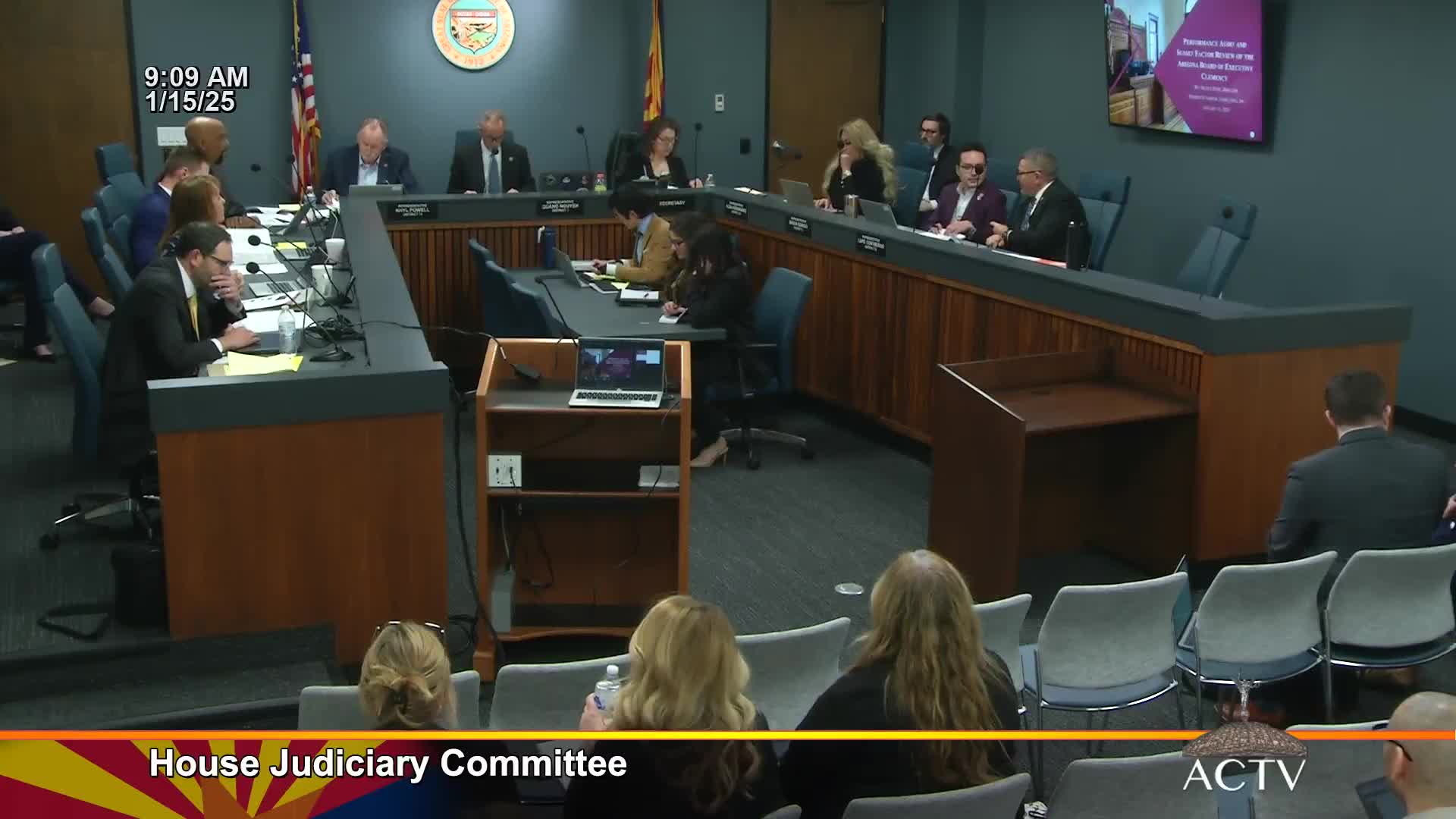
House Judiciary committee recommends revision of Arizona Criminal Justice Commission after questions on grants and data collection
Summary
After a Committee of Reference hearing, the House Judiciary Committee voted 6–3 to recommend revising the Arizona Criminal Justice Commission following member concerns about grant delays, an earlier lapsing appropriation, and proposals to collect personally identifiable information for criminal‑justice research.
The Arizona House Judiciary Committee voted to recommend that the Arizona Criminal Justice Commission be revised after a Committee of Reference hearing in which lawmakers pressed the commission on grant management, lobbying for a law‑enforcement data bill and privacy risks of proposed databases.
The recommendation followed a presentation by Andrew LaDeaver, executive director of the Arizona Criminal Justice Commission, who described the agency’s role as a state administering agency for federal criminal justice grants, its emphasis on data and victim services, and performance metrics dating from 2016 to 2024. LaDeaver told the committee roughly $207 million flowed through ACJC during that time, about 87% of which was passed through to local criminal‑justice agencies, and that the commission had reduced staff from 27 FTEs in 2016 to 20 in the current fiscal year.
The commission’s work and accomplishments drew praise and scrutiny. LaDeaver described victim compensation and assistance efforts that provided nearly $32 million in direct payments to more than 22,000 victims and funded services reaching roughly 174,000 people. He highlighted AZPoint, the Arizona Protective Order Initiation and Notification Tool, and told the committee the time to enter protective orders into NCIC had fallen from an average of 23 days to a majority being entered within seven days. He also summarized drug‑task‑force results the commission funds, including seizures the commission reported as “881,000 fentanyl pills, 16,000 of fentanyl, and 113 pounds of meth,” and stated those seizures supported about 266,730 drug prosecutions and roughly 145,000 convictions over the past eight years.
Members focused on operational problems and policy choices. Representative Alexander Collin read from correspondence from the Arizona Sheriffs Association alleging delayed grant distribution and other grievances. Collin said the sheriff’s association told him a $1,000,000 appropriation for a recidivism‑tracking project had lapsed and been returned to the general fund after ACJC did not obligate the funds in time. LaDeaver acknowledged the agency had “dropped the ball” on that item, explaining the appropriation had a one‑year availability period while program planning assumed a longer timeframe: “we did miss the fact that the $1,000,000 had only a 1 year term on it…that was our mistake,” he told the committee.
Committee members also pressed ACJC on delays with the Corrections and Sheriff Assistance Program (COSAP) grant, which members described as a $6,600,000 award for which about $4,000,000 remained undistributed. LaDeaver acknowledged delays in making those funds available and said some portions of the award produced no applications.
Another area of sustained concern was ACJC’s role in proposing criminal‑justice data collection bills. Representative Collin said the commission lobbied for legislation he described as requiring law enforcement to collect personally identifiable information on people not convicted of crimes. LaDeaver disputed some characterizations and said commission proposals were intended to give the Legislature access to criminal‑justice data for policymaking and that later amendments limited release of PII: “I don’t think we ever envisioned that would be released, but we’ve made sure it was specifically put forward in the language that that was gonna be the case,” he said. Members repeatedly asked whether the commission had advocated for a CCW (concealed‑carry) registry; LaDeaver said he did not recall ACJC advocating for creation of a CCW database and described the commission’s interest as ensuring an electronic mechanism to verify a CCW permit’s validity at the point of purchase.
After the presentation and questioning, Vice Chairman Kyle Powell moved that the committee recommend ACJC be revised. The motion passed on a recorded voice roll call; the committee chair announced the “ayes have it.” The committee’s recommended action instructs the Legislature to consider modifying the commission’s statutory scope; members stated the precise modifications would be determined in follow‑up work and stakeholder meetings.
The committee’s discussion included both operational critiques (missed procurement timelines and slow grant distribution) and policy worries about data privacy and lobbying. LaDeaver and other ACJC staff also described steps the commission said it has taken to increase efficiency — electronic grants management, DocuSign for agreements, and public data‑visualization tools — and defended the commission’s overall low overhead and high pass‑through rate.
The committee did not adopt specific statutory language at the hearing; members directed staff and chairs to continue conversations about the agency’s scope and to produce recommended statutory changes for future consideration.
Votes at a glance: The committee moved, by voice roll call, to recommend the Arizona Criminal Justice Commission be revised; the chair announced a 6–3 vote for revision.
—
Sources: Testimony and presentation by Andrew LaDeaver, Executive Director, Arizona Criminal Justice Commission; committee Q&A; committee motion and roll‑call announcement.