Get AI Briefings, Transcripts & Alerts on Local & National Government Meetings — Forever.
JLBC tells Senate education committee Arizona schools receive roughly $12 billion in agency resources, $16.5 billion systemwide
Loading...
Summary
The Joint Legislative Budget Committee presented a high‑level overview Monday of K‑12 funding in Arizona, telling the Senate Education Committee that ADE has roughly $12 billion in total resources for fiscal year 2025 and that the statewide public school system receives about $16.5 billion when local property tax collections are included.
The Joint Legislative Budget Committee presented a high‑level overview Monday of K‑12 funding in Arizona, telling the Senate Education Committee that ADE has roughly $12 billion in total resources for fiscal year 2025 and that the statewide public school system receives about $16.5 billion when local property tax collections are included.
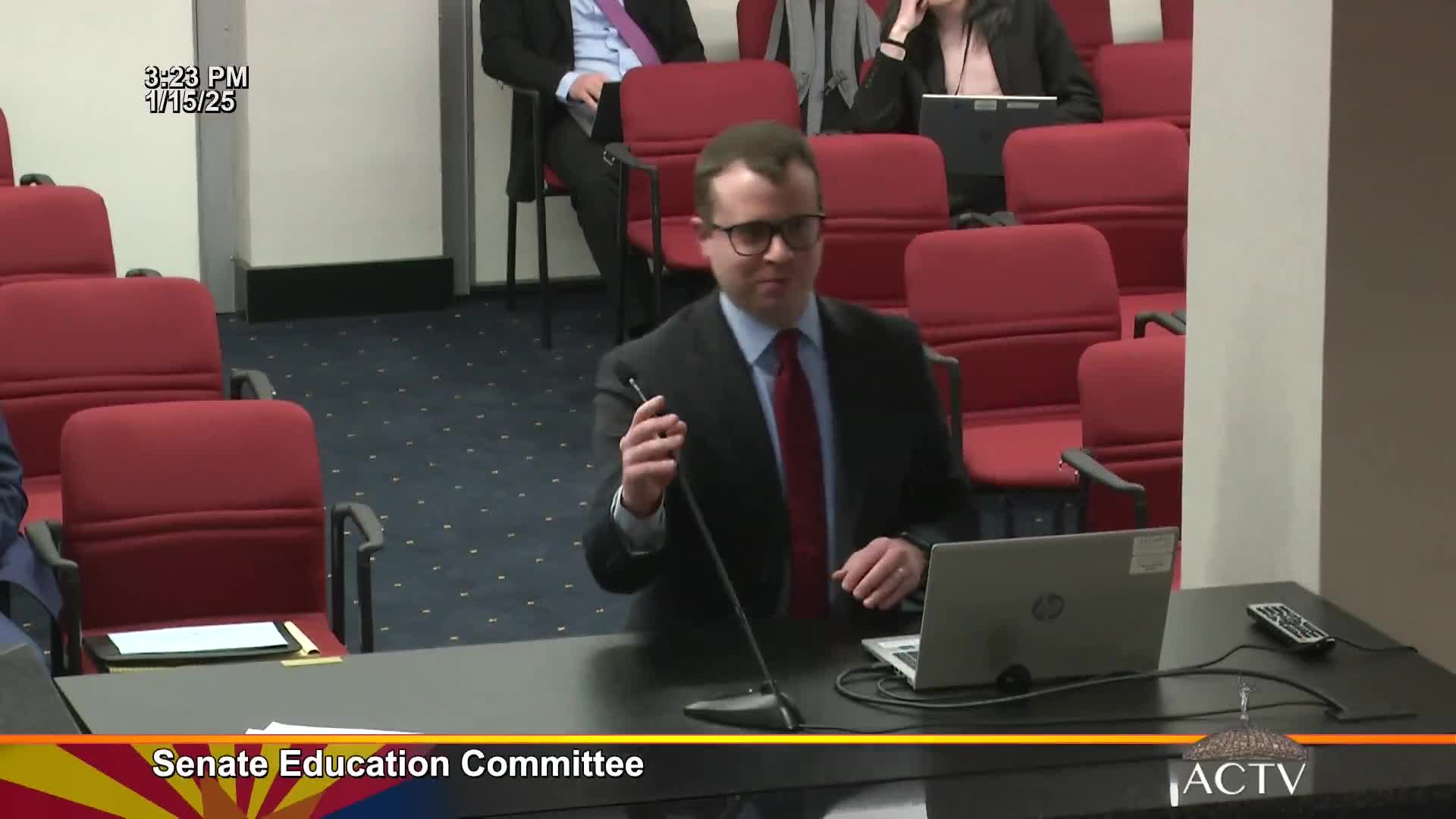
The JLBC briefing, given by Patrick Moran, laid out the mechanics of the basic state aid formula — the statutory “base support level,” the role of average daily membership (ADM) and two classes of weighting adjustments that increase the base student count to a higher “weighted” count used to allocate most state aid.
“From a total resource perspective, in the enacted FY2025 budget ADE has about $12,000,000,000 of resources from all funds,” Moran said, adding that roughly $7.7 billion of that comes from the state general fund and about $2.6 billion from federal programs. He said property taxes are accounted for in the formula but are set and collected locally and therefore do not flow through ADE’s budget totals.
Why it matters: basic state aid is the single largest line in ADE’s budget and understanding how the formula converts student counts into dollars determines how funds flow to districts, charters and empowerment scholarship accounts (ESAs). JLBC staff emphasized that the statutory base support level — currently described as $5,013 per weighted pupil in the presentation — and adjustments for inflation required by Proposition 301 are central to annual funding calculations.
Key details from the presentation:
- ADE’s total resources for FY2025 were presented as about $12 billion; the statewide public school system totalled about $16.5 billion when local property taxes are included.
- JLBC estimated an unweighted ADM of about 1,080,000 pupils; after statutory group A and group B weights (district/school and student‑level weights, respectively) the weighted pupil count rises to roughly 1.55 million, which is the primary basis for the largest portion of formula funding.
- The base support level multiplied by the weighted count produces most formula funding (JLBC showed this generating about $7.87 billion). Proposition 301 also requires annual inflation adjustments to the base level and to the transportation per‑mile amounts.
- Other statutory components discussed included additional assistance (a per‑pupil amount historically tied to capital), transportation funding based on route miles (about $214 million), homeowners’ property tax rebates (about $527 million) and funding for empowerment scholarship accounts (ESAs), which JLBC estimated at roughly $822 million in the enacted budget but noted current ESA enrollment would generate a somewhat higher amount.
JLBC staff also outlined how property‑wealth differences across districts change the state’s share: districts with low property wealth receive more state backfill while so‑called non‑state‑aid districts can generate their formula allocation from local taxes.
Questions from committee members focused on the split between group A and group B weights and on how ADM and weights translate into the weighting increases. JLBC staff said group B weights (student‑level, e.g., special education, English‑language learners, K‑3 reading) add several hundred thousand weighted pupil equivalents statewide and that the split between group A and group B contributions to the weighted total is roughly even.
The presentation and slides are posted by JLBC on its website, and committee members were invited to follow up with additional questions.
The committee did not take a vote on any policy during the presentation; JLBC provided the overview for informational purposes.