Get Full Government Meeting Transcripts, Videos, & Alerts Forever!
Get email alerts on the Elections Voting topic
No spam. Unsubscribe anytime.
Senate committee advances bill tightening early-ballot drop-off window, adds optional weekend voting sites
Summary
The Arizona Senate Judiciary and Elections Committee voted 4-3 to advance SB1011, a bill that would require most early ballots to be deposited at voting locations by 7 p.m. the Friday before election day, change early-voting logistics and allow optional on-site tabulation and weekend/Monday early voting at some counties.
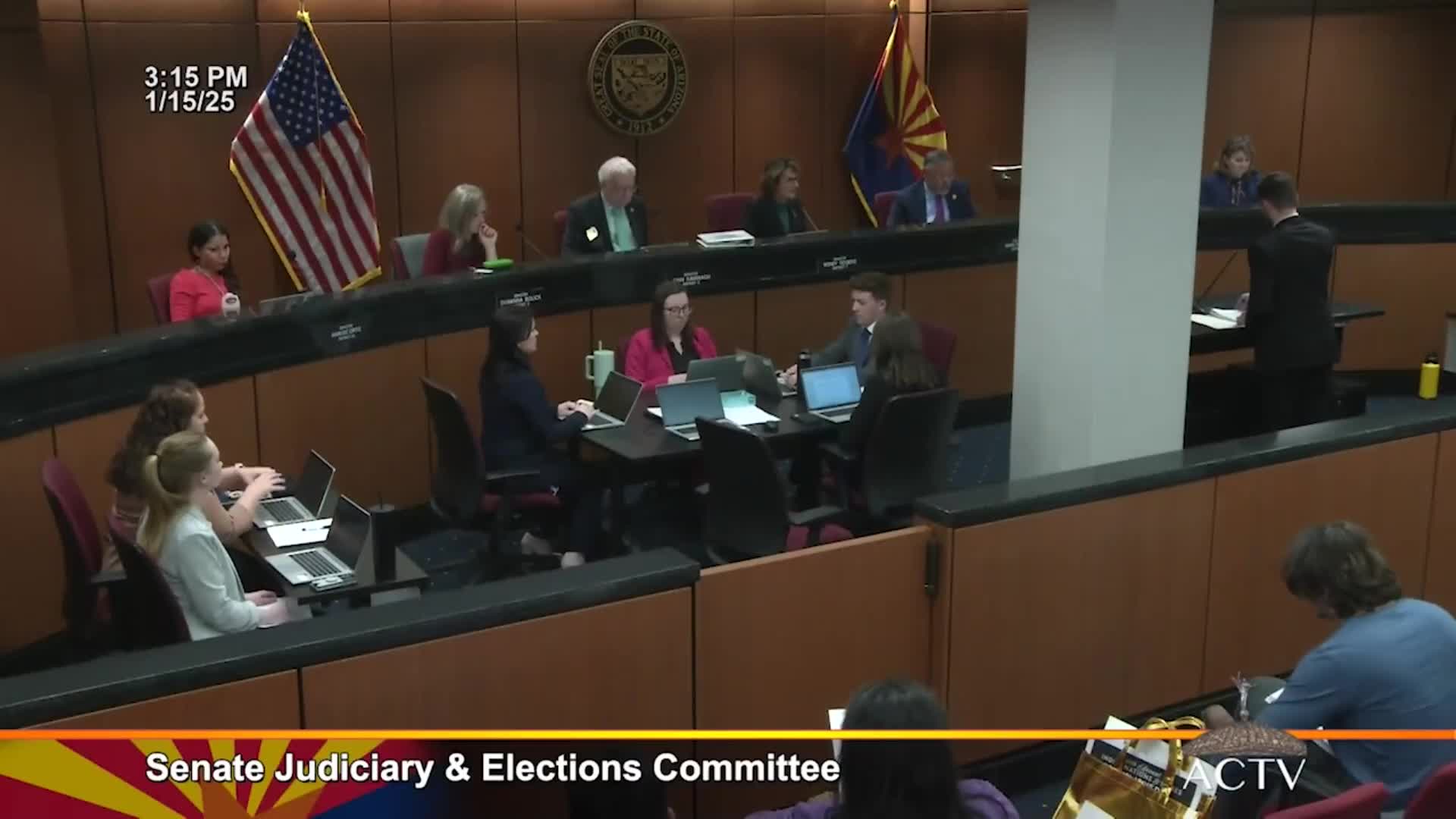
Senate Judiciary and Elections Committee members advanced Senate Bill 1011 after more than three hours of testimony and debate over whether faster election-night results justify changing long-standing early-ballot procedures.
The bill, as amended in the committee, would require that ballots deposited at county voting locations be received by 7 p.m. on the Friday before election day to be counted as a voted early ballot. It also allows county recorders to mail early ballots as early as 29 days before election day (up from 27), makes on-site tabulation at early voting locations possible where counties provide the means, and makes the Saturday and Monday immediately before election day optional (a "may") for counties that choose to open on-site early voting and tabulation. The committee adopted a 17-page amendment in the chair's name before voting the bill out with a 4-3 recommendation.
President Peterson, who sponsored the measure, told the committee the bill is "constituent-driven" and urged members that the changes would produce faster, more trustworthy election-night reporting. "One of the biggest causes of people not trusting the elections is that delay that is caused after," Peterson said, arguing that earlier cutoffs for late-arriving ballots would let recorders finish signature verification and report results more promptly.
Supporters at the hearing, including the Maricopa, Pinal and several other county recorders, said reducing the number of late-deposited ballots would shorten the period that election results remain incomplete and allow counties to process ballots more efficiently. Maricopa County Recorder Heap said the earlier drop-off deadline is the bill’s most consequential change and told the committee the three-day gap would let recorders "catch up" so results can be reported on election night.
Opponents — including civil-rights groups, tribal-area officials, rural advocates and some county staff — warned the bill would create confusion and practical barriers for voters who rely on last-minute drop-off on election day, especially in rural and tribal areas with sparse facilities, limited post-office hours and long travel distances. Pima County Recorder Gabriela Casares Kelly said many parts of her county are large and remote; she said Pima had zero ballot drop boxes in the last cycle and noted the threat of political violence and bomb threats at voting locations last cycle that required evacuations.
"For many of those people in those rural locations, even though we have vote centers that are based on precinct, there's usually only one facility available," Casares Kelly said, explaining that the change could force some residents to travel much farther to deliver ballots.
Testimony highlighted concrete figures discussed during the hearing: 264,554 early ballots were recorded as dropped off on election day statewide in one presentation cited by witnesses, Maricopa County staff noted roughly 265,000 early-ballot drop-offs on election day in that county during the most recent cycle, and Pinal County said it processed around 10,000 late early ballots in the last election (about 5% of its turnout). Witnesses and county officials urged that shifting these ballots to earlier deadlines could significantly increase lines on election day without additional funding or staffing.
County election officials and advocates proposed alternatives or mitigations: expanding early in-person hours (for example keeping early-voting centers open later during the month leading up to election day), adopting central-count processing during election day, investing in equipment to speed signature verification, and funding broad voter-education efforts to avoid surprising voters with the change. The Arizona Association of Counties urged legislative cleanups, clearer statutory language on instructions and ID requirements, and funding for voter education and county implementation costs.
Supporters argued the bill balances access and speed: the amendment removed a strict requirement that counties open Saturday and Monday early voting and instead made that optional while permitting counties to begin mailing ballots two days earlier. Sponsor Peterson told the committee the amendment also reinserted existing statutory language allowing a voter to present a valid ID so that a voted early ballot can bypass additional signature verification.
Several witnesses described election-day security incidents in tribal and rural areas during the prior cycle. Committee members and the secretary of state's office acknowledged courts have been asked to extend polling hours in exigent circumstances and that the Arizona Supreme Court had been involved in extending hours at some locations after threats or disruptions.
After lengthy discussion and 90-second public testimony slots for dozens of speakers, the committee adopted the chair's amendment and then gave SB1011 a due-pass-as-amended recommendation in a roll-call outcome of 4 ayes and 3 noes. The committee record shows a mix of votes and explanations by members during the roll call. The committee chair, Senator Wendy Rogers, and other proponents framed the bill as an effort to produce timely results while preserving or expanding other voting opportunities; opponents said the change risks confusing voters and reducing practical access unless the state and counties commit funding and infrastructure improvements.
The bill now moves to the full Senate, where sponsors and county officials indicated they plan further technical amendments and discussions about funding and implementation details.
Ending: Committee members and witnesses said they expected additional cleanup amendments before floor consideration and urged the Legislature to pair statutory changes with targeted funding and voter education so the shift in deadlines would not inadvertently disenfranchise voters who have relied on last-minute drop-off.