Get Full Government Meeting Transcripts, Videos, & Alerts Forever!
Get email alerts on the Transit topic
No spam. Unsubscribe anytime.
Trinity Metro outlines growth, TexRail medical-district extension gains federal funding but few short-term operating revenues
Summary
Trinity Metro told Fort Worth council on Jan. 14 that ridership has recovered, on‑demand services are growing, and the TexRail extension to the Medical District has most of its capital secured after a federal grant boost.
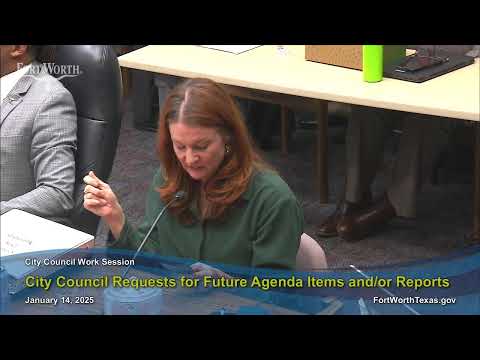
Rich Andreski, president and CEO of Trinity Metro, told Fort Worth council members at the Jan. 14 work session that ridership has recovered since the pandemic, new services such as the Orange Line were well received and the agency is rethinking its network to attract more “choice” riders.
Andreski said TexRail’s planned two‑mile extension to the Medical District, including a rail yard expansion and four new trains, is a roughly $295 million program and that “as of Friday” the project had $270 million secured, including an enhanced federal grant of $25 million. He asked council and the region to keep supporting the project, which he said could break ground by the end of this year if funding is finalized.
Nut graf: Trinity Metro officials said the system is seeing demand shifts — growing on‑demand and rail ridership in different markets — but cautioned the agency is financially exposed because it relies heavily on a half‑cent local sales tax and on federal formula dollars for operating and capital needs.
What Trinity Metro said: Andreski described several trends and projects. Ridership, he said, has returned and changed in composition: users are increasingly younger and more demographically diverse. The agency launched the Orange Line and plans to launch a Blue Line and a strategic action plan in 2025; it also will introduce Trinity Metro Bikes and expand on‑demand services. He said regional benchmarking showed peer cities invest roughly double Trinity Metro’s per‑capita transit spending, and that Trinity Metro currently supports a calculated $700 million in annual economic impact and about 37,100 jobs.
Financial concerns: Andreski warned the agency is “over‑dependent” on the half‑cent sales tax, which Trinity Metro uses for core operations, and on federal formula funds. He said the agency has increased use of federal formula money for operations and capital and that leaves fewer local funds for maintenance and replacement over time. Andreski and council members also discussed long‑range choices such as double‑tracking TRE segments, regional funding arrangements and how rail investments can catalyze transit‑oriented economic development.
TexRail specifics: The medical-district extension would add two miles of track, a rail yard expansion and four trains; Trinity Metro staff reported a $295 million program cost and that $270 million of the total was in place after a federal grant enhancement. Andreski said the region purchased four cars and that the car purchases were funded by the region. He said the agency still needs to finalize remaining funding and that the cost‑escalation risk remains until project bids are awarded.
Council reaction: Council members welcomed the update and pressed Trinity Metro on network redesign, service tradeoffs between fixed routes and on‑demand services and the need to diversify revenues. Several members said Trinity Metro’s board representation and stronger city‑agency coordination have helped operations and communication.
What’s next: Trinity Metro plans to release a strategic action plan, move forward on the Blue Line and complete federal‑funding steps for the TexRail extension; local officials and the agency will continue conversations about regional funding models for commuter rail improvements and doubling TRE segments.
Source: Remarks and slide presentation by Rich Andreski and Trinity Metro staff at the Fort Worth City Council work session, Jan. 14, 2025.