Get Full Government Meeting Transcripts, Videos, & Alerts Forever!
Get email alerts on the Ems Transition topic
No spam. Unsubscribe anytime.
Fort Worth and Local 440 reach MOU for MedStar transition; council to consider agreement Jan. 28
Summary
City negotiators and Local 440 reached a memorandum of understanding to move MedStar EMS employees into Fort Worth’s civil service structure; the agreement sets pay, benefits and staffing assumptions and will be presented to council Jan. 28.
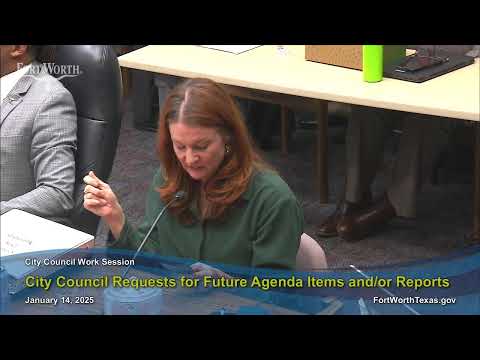
Fort Worth city negotiators and Local 440 reached a memorandum of understanding (MOU) covering the transition of MedStar Emergency Medical Services (EMS) employees into the Fort Worth Fire Department and the city’s civil service structure, city staff said during the Jan. 14 work session.
The MOU, which city staff said the union’s membership already ratified, governs EMTs, paramedics and telecommunicators moving to the city and is intended to align EMS bargaining with the city’s existing fire collective bargaining cycle. City staff told council the MOU is effective July 1, 2025 — the day the transition is planned to conclude — and that the council will consider a Municipal Order (M&C) to approve the agreement at the Jan. 28 work session.
Why it matters: The agreement creates a promotional and rank structure for newly city‑employed EMS personnel, sets operational targets and lays out a two‑year financial framework staff said is needed to implement the change. Council members and staff said they are focused on ensuring service continuity, employee payroll accuracy and long‑term funding for EMS operations.
Key provisions and figures: City negotiators said the MOU term as drafted is short (July 1 through Sept. 30) to align future EMS bargaining with the city’s fire collective bargaining schedule. City staff reported a preliminary two‑year cost of approximately $54.4 million for salaries, benefits and related items tied to the transition; staff described that as the cost to bring existing MedStar positions and pay structures into the city payroll and benefit system.
Operational targets included in the agreement were described in the work session as: a reduction in unit‑hour utilization (a workload metric) from 0.67 to 0.50, a service goal of an 8‑minute travel time for 90% of Priority 1 calls, and a tiered mix of advanced life support (ALS) and basic life support (BLS) resources. Staff said achieving the planned service levels will require roughly 75 additional full‑time positions and nine additional ambulances under the plan.
City staff described workforce and implementation steps: MedStar employees will be offered civil service positions without reapplying; new job classifications and a single‑role firefighter classification were developed for personnel moving from MedStar into the fire department structure. The city’s negotiators said they built parity into some incentive and benefit language so the incoming EMS employees see similar structures to existing fire department employees.
Payroll and billing: City staff told council they will keep MedStar billing and payroll operations on a third‑party platform during the transition to avoid disruption. City Human Resources and finance staff said the city will contract with ADP to manage payroll in the interim while IT and payroll integration projects continue; staff said onboarding EMS employees into the city payroll will be staged so as not to disrupt ongoing transitions already under way for police and fire payroll modernization. City and MedStar staff also said MedStar’s ambulance-transport billing is operating through an outside vendor (identified as EMSMC in staff remarks), and city staff will evaluate contracts and options during and after the transition.
Employee outreach and conditions: City negotiators described a significant communication effort with MedStar employees, including town halls, committee-level private sessions, and access to bargaining sessions. City staff emphasized support services and a “last chance” policy negotiated with the union — a program to route employees into dependency counseling in lieu of immediate termination in certain cases, with union and city cooperation.
Next steps: City staff presented the draft MOU and asked the council to consider a Municipal Order on Jan. 28 that would approve the agreement. City staff said they will continue work on final payroll integration, vendor contracting for EMS billing and a detailed fiscal plan for FY26 to present to the member cities and council.
Speakers on the topic included Assistant City Manager Valerie Washington, Fire Chief John Davis, City HR Director Diana Giordano and city negotiators; Local 440 leadership attended the work session and the union membership ratified the agreement, staff said.
Sources: Presentation and remarks by Assistant City Manager Valerie Washington, Fire Chief John Davis and HR and finance staff during the Fort Worth City Council work session, Jan. 14, 2025.