
State chief data officer outlines data and AI strategy, requests governance tools and staffing
Get AI-powered insights, summaries, and transcripts
Subscribe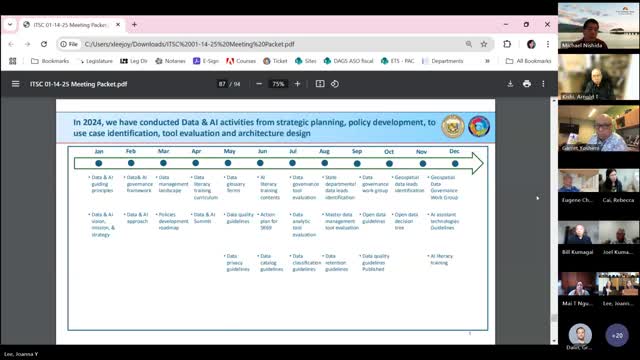
Summary
Chief Data Officer Rebecca Cai told the IT Steering Committee that the data and AI program has completed several deliverables and is seeking tools for master data management, data governance and a statewide data platform, and that additional staff will be needed beyond the current two‑person team.
Rebecca Cai, the state’s Chief Data Officer, briefed the Information Technology Steering Committee on Jan. 14 on the Office of Enterprise Technology Services’ data and AI strategy, including completed deliverables, an architecture vision and near‑term tool and staffing needs.
“We are a team of 2, including me,” Cai said at the start of her presentation, summarizing 2024 progress and the road map for 2025. She listed 14 deliverables tied to a five‑goal strategy; Cai said 10 deliverables were completed in 2024 and four were scheduled for 2025, including a data and AI glossary and data‑literacy training published on data.hawaii.gov.
Why it matters: Cai said a shared statewide data platform, master data management and data governance tools would reduce duplicate work, improve data quality, and make shared datasets available for decision‑making across departments while protecting privacy and security.
Major points from the update - Deliverables and classification: Cai said the team completed seven documents that are now labeled as guidelines rather than enforceable policies because the state lacks enforcement authority for them; the guidelines are pending final review by the attorney general before publication. - Architecture and the ‘middle layer’: Cai described an architecture in which individual departments maintain departmental ecosystems while a centralized “lakehouse” or statewide data platform hosts shared datasets, master data management and governance tools to translate differing definitions (for example, geographic regions) among departments. - Master data and citizen records: Cai offered the example of wildfire survivors who had to re‑submit the same documents to multiple programs; a master citizen record, with consent and controls, could reduce repeated submissions. - Data governance and cataloguing: Cai said the state lacks a searchable catalog and automated access requests; a governance tool would list datasets, owners and enable request/approval workflows. - Responsible AI: Cai and committee members discussed the risks of generative AI, data leakage, trustworthiness and the need for human review. Cai said planned guidance will address what data can be put into generative AI tools and how to assess data quality prior to AI usage. - Staffing and resourcing: Multiple committee members asked whether the two‑person team can deliver the program. Cai said more staff are needed for data governance, quality, master data management, data engineering, and analytics. ETS staff later said a $1.6 million request is included in the ETS budget for 2025 in the presentation earlier, though Cai did not tie a specific hiring number to that amount in the committee briefing.
Committee questions and follow up Bill Kumagai and others asked about buy‑in from departments and about “anchor tenants” for an initial shared use case. Cai said the work should proceed with focused, business‑driven use cases rather than a “big bang” approach, and that departments had indicated willingness to co‑finance shared tooling when they can see demonstrable benefits.
On AI, committee members asked how the state would balance adoption and risk. Cai listed four concerns—data input, output trustworthiness, human‑in‑the‑loop review and copyright—and said the state is developing guidance and working with an AI coalition of CDOs in other jurisdictions to build risk management practices.
Ending: Cai said the program is a multi‑year effort that will progress through use‑case pilots, tool procurement and incremental staffing increases; committee members asked ETS to return with additional detail on resource needs and planned pilots.