Get Full Government Meeting Transcripts, Videos, & Alerts Forever!
Get email alerts on the Ems Services topic
No spam. Unsubscribe anytime.
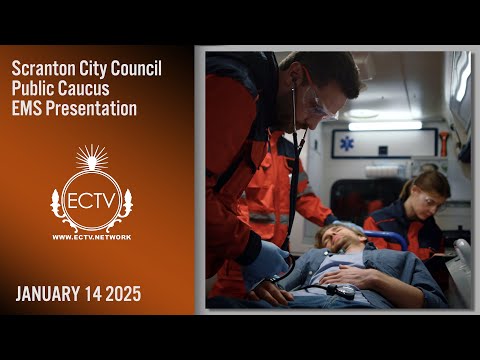
Pennsylvania Ambulance tells Scranton council it meets response-time norms, offers to contract
Summary
Pennsylvania Ambulance leaders told Scranton City Council members at a caucus meeting that the company's average emergency response time in the city is about 7 to 8 minutes and disputed an outside report that claimed an 18-minute total response time.
Pennsylvania Ambulance leaders told Scranton City Council members at a caucus meeting that the company's average emergency medical response time in the city is about 7 to 8 minutes and that a separate report claiming an 18-minute total response time is incorrect.
The presentation, led by a physician identified in the transcript as Dr. Bernetti, disputed figures attributed to Fitch and Associates and said the Lackawanna County 911 center's dispatch data show median response times between about 6 minutes 21 seconds and 7 minutes for 2022'2024 (through July 1, 2024). "We would be happy to sit down with you and whatever cadence you would like and show you what our staffing patterns are, what our response times are," Dr. Bernetti told council members.
Why it matters: Council members said they have considered whether the city should operate its own ambulance service and raised cost and staffing concerns. Creating a municipal ambulance service, council members observed, would require multiple ambulances, 24-hour staffing across shifts, upfront vehicle purchases and ongoing operating costs. One council speaker estimated a municipal service could cost about $2 million to $4 million per year.
Pennsylvania Ambulance presented several data points and community-service items: the company reported handling roughly 7,000 calls so far in 2024; said its median/average response times match pre-COVID national medians (a JAMA analysis cited a median of about 7 minutes); and compared that to New York City, which the presenters said was 8 minutes in 2014 and about 14 minutes in 2024. The presenters also described donations and training they've provided locally, including donated AEDs (2016), stop-the-bleed and tactical EMS training (2017'2019), PPE donations (2020), and a plan to donate two ambulances in 2025 to nonprofits serving people experiencing homelessness.
Company capacity and operations: Pennsylvania Ambulance said it operates more than 40 ambulances systemwide, purchased about 10 new ambulances this year, staffs transport vehicles with two personnel and staffs quick-response vehicles with one paramedic, and that daytime call volume can place 15 to 20 vehicles in service while overnight service typically falls to three to four transport vehicles plus quick-response units. The presenters said the county 911 center can see ambulance GPS locations and dispatch the closest available unit. "No cost. No taxes. That's what you get from Pennsylvania Ambulance," one presenter said, summarizing the company's current arrangement with Scranton.
Billing and network participation: The presenters said they bill Medicare, "medical assistance," Blue Cross Blue Shield and Geisinger; they also referenced Act 6 for auto insurance billing. They rejected the use of an undefined "soft billing" term and said the company has hardship policies for patients who cannot pay.
Operational limits flagged: Presenters and council members described another major factor affecting response capability: prolonged emergency department wait times that tie up ambulances at hospitals. The company said crowded ERs at local hospitals, and the closure of one emergency department (Moses Taylor), are causing ambulances to remain at hospitals for extended periods, reducing available units for 911 responses.
Council response: Several council members said the existing private-provider model is handling calls and that they preferred negotiating with the company rather than immediately forming a municipal ambulance service. One council member proposed asking the mayor to set a meeting with the chief (the city's chief referenced in the discussion) and Pennsylvania Ambulance to try to reach a formal contract; another council member seconded that motion and members agreed to take the item to a formal meeting for action.
The presenters provided to council members (per the transcript) copies of their slide deck and offered follow-up meetings and collaborative options such as placing personnel at fire stations or other system-status locations. "We're prepared and ready," a company representative said.
Ending: Council members directed that the administration pursue talks with the mayor and chief and said they would consider a formal motion at a subsequent council meeting to request a meeting and report back on potential contract terms.