Get Full Government Meeting Transcripts, Videos, & Alerts Forever!
Get email alerts on the School Funding Legislation topic
No spam. Unsubscribe anytime.
Board member flags potential state funding cuts after two Colorado studies
Summary
A trustee summarized two state studies on school funding and warned the board that proposed legislative changes could reduce district revenue, citing a potential $192 million statewide cut and an estimated $1.5 million impact to the district if the five-year enrollment average is removed.
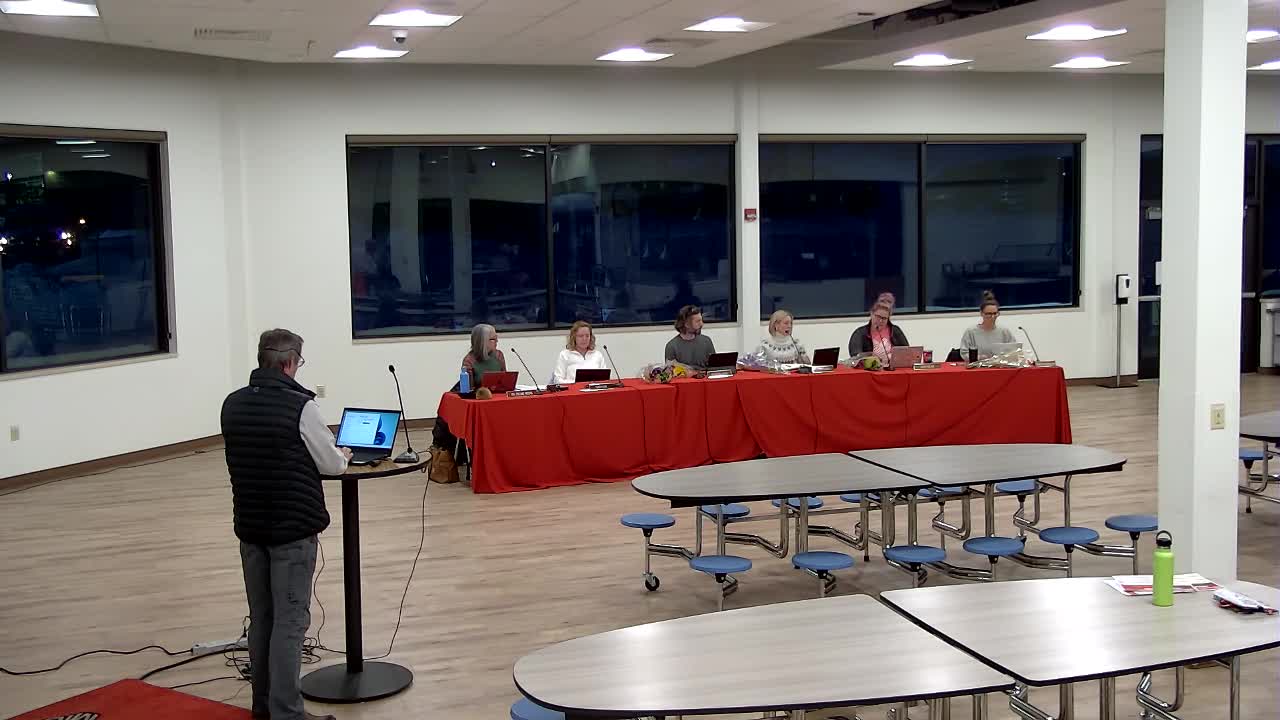
Board member Leah Helm briefed trustees on recent Colorado education funding studies and legislative developments during board member updates on Jan. 13, telling colleagues that state proposals could reduce K–12 funding and that district advocacy will be needed.
Helm summarized two state reports — an equity-and-adequacy study and an input-based financial adequacy study — and relayed their headline findings: Colorado teacher pay is low and uneven, funding should better account for at-risk and disabled students, and adequate statewide funding would be billions higher than current levels. “Both studies concluded that Colorado teacher salaries are too low and the tax system that supports schools is inadequate,” Helm said.
She told the board the input-based study estimated adequate funding would be about $3.5 billion higher than current levels, with portions of that total tied to at-risk and special-education funding and district size and cost-of-living adjustments. The equity-and-adequacy study recommended raising teacher pay, increasing funding weights for at-risk students and adjusting for regional cost differences, she said.
Helm also relayed a legislative issue she said CASB’s Legislative Resolutions Committee had discussed: a proposal to end broad use of the five-year enrollment average used to calculate state funding for districts. Helm said removing that five-year average would reduce statewide K–12 funding by about $192 million and estimated a roughly $1.5 million loss for the Steamboat Springs district if the change were enacted. “We all have a lot of work to do in this coming year because … the removal of the five year average would see a $192,000,000 leave education,” Helm said.
Trustees noted the complexity and timing of state budget calculations and asked that the topic be scheduled for a future meeting agenda or workshop so the board could discuss advocacy strategies. Helm told trustees she would try to bring the matter back at a subsequent meeting so the board could consider implications and potential responses.
The board did not take formal action on the studies or the legislative proposals at the Jan. 13 meeting; Helm’s remarks were presented as a board-member update and as a prompt for future discussion and possible agenda items.