Get Full Government Meeting Transcripts, Videos, & Alerts Forever!
Get email alerts on the Energy Infrastructure topic
No spam. Unsubscribe anytime.
We Energies seeks permit amendment to convert Elm Road power site from coal to LNG, add five gas turbines; planning commission recommends council approval
Summary
We Energies asked the Oak Creek Planning Commission to recommend a conditional use permit amendment that would allow conversion of operations at the Elm Road generating station from coal to liquefied natural gas (LNG) and construction of five natural-gas-fired combustion turbines and an on-site LNG storage tank.
We Energies asked the Oak Creek Planning Commission to recommend a conditional use permit amendment that would allow conversion of operations at the Elm Road generating station from coal to liquefied natural gas (LNG) and construction of five natural-gas-fired combustion turbines and an on-site LNG storage tank.
The company said the conversion is driven by changes in regional grid planning and federal environmental rules, and is part of the utility’s stated goal of reaching net-zero emissions by 2050. Jennifer Bogner, director of local affairs for We Energies, said the regional grid operator (MISO) has shifted to a seasonal-peak planning model and that an EPA rule discussed in the presentation requires utilities to either retire coal units or install carbon capture — a technology the company said is not commercially viable in the region.
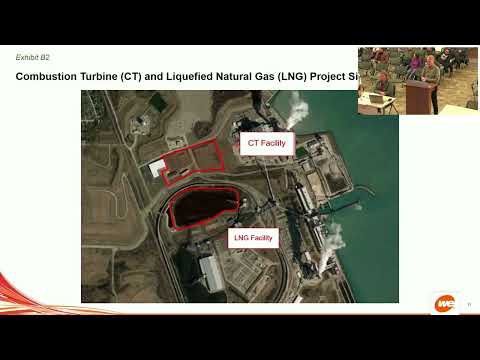
At the Planning Commission meeting, We Energies described the Elm Road project as two linked elements: five General Electric combustion turbines to provide fast-start, peaking capacity, and a full-containment LNG storage and liquefaction facility to provide local fuel supply in cold-weather or other high-demand periods. Company representatives said the combustion turbines are intended to “fill the gaps for when the wind’s not blowing and when the sun’s not shining.” Rick (We Energies representative) said the combustion turbines have an expected capacity factor of about 20%, meaning they are intended to operate mainly during peak demand. The company stated the combustion-turbine portion of the project is budgeted at approximately $1.2 billion and the LNG portion at about $456 million.
Project schedule details presented to the commission included planned regulatory filings with state agencies (the Public Service Commission and state Department of Natural Resources), long lead equipment deliveries, and a staged construction timetable. The company said it expects turbine equipment delivery in 2026–2027, to place the first turbine in operation by the end of 2027 and the final turbine by summer 2028. The LNG tank and liquefaction equipment were described as expected to be in service by the end of 2027 if approvals and permitting proceed on the stated schedule. We Energies said earlier outages and retirements at Oak Creek and Elm Road will remain in effect while the conversion proceeds.
On technical points, presenters described the LNG tank as a full-containment vessel with an inner 9%‑nickel alloy tank, an outer carbon-steel shell, and concrete containment. The tank dimensions cited in the presentation included a maximum height of about 170 feet and a diameter of roughly 206 feet. The combustion-turbine site plan showed two separate ATC interconnection blocks (a 138 kV block and a 345 kV block) and ancillary compression and cooling equipment. Company staff said they plan to use existing nearby substations to minimize new transmission work.
Safety and regulation were discussed at length. Bogner and the company representative said the project will follow federal and industry safety standards overseen by agencies and bodies they named in the presentation, including PHMSA (Pipeline and Hazardous Materials Safety Administration) and NFPA (National Fire Protection Association), and that an emergency response plan will be coordinated with Oak Creek fire officials. Amy Jibb, lieutenant with the Oak Creek Fire Department, said the department will work with the company on training and response planning.
Several residents asked questions about safety, tank removal and construction traffic. One resident asked whether an existing, older LNG tank on-site would be removed; company representatives replied the intent is to retire and remove the older tank but that retirement requires approval from the state Public Service Commission. Another resident asked about construction traffic and neighborhood impacts; presenters said construction traffic would be routed principally on Highway 32 and that the city and company will coordinate on shift times and traffic management.
Following the presentation and public questions, Commissioner Burke moved that the Planning Commission recommend the Common Council approve a conditional use permit amendment for the Elm Road site after a public hearing and subject to conditions and restrictions. The motion passed on a roll call vote; the company and staff noted the item will proceed to a public hearing before the Common Council (the Planning Commission noted a council hearing was scheduled for Monday, Feb. 17, per the presentation).
Why it matters: The project would repurpose a long-standing coal-fired generation site into natural-gas-fired assets and on-site fuel storage. We Energies framed the work as a bridge to future renewables and as a response to federal and regional planning changes. The scale, the multi-hundred-million-dollar cost, the interconnection to existing transmission infrastructure, and the on-site LNG storage prompted detailed questions from city staff, commissioners and nearby residents.
Next steps: The Planning Commission recommended council approval; the conditional use permit amendment and related conditions will be considered by the Common Council at a public hearing. The company said it will also pursue required state regulatory approvals.