Get Full Government Meeting Transcripts, Videos, & Alerts Forever!
Get email alerts on the Beaches Vending topic
No spam. Unsubscribe anytime.
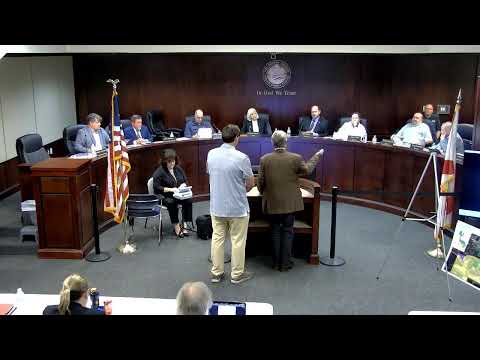
Walton County awards managed-beach concession to Coastal Paracel after heated public debate
Summary
The Board of County Commissioners voted 4–1 to authorize staff to draft a contract awarding managed beach chair and umbrella services to Coastal Paracel, a decision that drew more than two hours of public comment about traffic, public access and local vendors.
The Walton County Board of County Commissioners voted 4–1 on Jan. 14 to approve the recommendation of county staff to award the managed beach services RFP to Coastal Paracel, which proposed an annual concession fee of $1,530,000.
Supporters of the award said the RFP process produced a significantly higher revenue offer than the county’s current managed vendor program, while opponents argued the process excluded community input and risked privatizing public beach access.
Why it matters: The single-vendor versus multi-vendor question divides local business owners and residents. The winning single-vendor proposal would raise the county’s annual revenue from roughly $374,000 under the current managed vendor program to more than $1.5 million, but some residents and local vendors told commissioners the public had not been adequately consulted and that the change could reduce informal public access and undercut small local businesses.
At the Jan. 14 meeting, Code Director Tony Cornman summarized the RFP results for commissioners and staff. Cornman said five firms submitted whole‑beach proposals and the review committee ranked Coastal Paracel highest; he told the board the company’s proposed annual concession fee was $1,530,000, compared with an alternate “zones” approach that would have generated about $1,105,000 annually.
Cornman also described operational details the RFP preserved from the county’s existing managed program: vendors must set up only when a paying customer is present, may operate only during specified daytime hours and are limited by the county’s method of allocating equipment by square footage at each beach access.
Dozens who spoke during the public comment period urged the board to reject the award, saying the RFP lacked a formal community outreach phase and that a single vendor would ‘commercialize’ public beaches and push smaller local vendors out of business. Todd Roark, a local resident and business consultant, told commissioners, “We don’t need $1,500,000 if it comes at the cost of our public beach.” Several current beach operators said they support competition and cautioned that a single-vendor contract could be delivered by outside companies rather than local firms.
Commissioners debated alternative steps including rejecting all proposals and reissuing the RFP, tabling the award to allow a community study, or approving the award and then negotiating contract terms that would protect public access and set explicit limits (for example, listing specific allowed equipment and prohibiting parasailing). County staff and several commissioners said many contract details (hours, permitted equipment, enforcement, dedicated beach‑infrastructure funds) would be settled in a later contract and could be adjusted before final execution.
Outcome and next steps: The board voted to instruct staff to prepare a contract with the awarded bidder, with an approval vote of 4 in favor and 1 opposed. Commissioner Anderson cast the sole “nay.” Staff said they would return a draft contract to the board for final review at the next meeting; the RFP called for a two‑year contract with two one‑year renewal options. Several commissioners said they expected the contract to include explicit prohibitions (for example, no parasailing unless the ordinance is changed) and enforcement provisions, and recommended setting up a restricted account for beach‑generated revenue for beach‑serving infrastructure.
Quotes: Tony Cornman, Walton County code director: “The winning proposal…was Coastal Paracel, who offered an annual concession fee of $1,530,000.”
Ending: Commissioners who supported the award said the county would draft contract language to protect public use and build enforcement and monitoring into the agreement; opponents said they would renew efforts to seek alternative approaches, including zone awards or reissuance of the RFP with a formal community outreach step. The contract draft will return to the board for final approval at a subsequent meeting.