Get Full Government Meeting Transcripts, Videos, & Alerts Forever!
Get email alerts on the Wastewater Treatment topic
No spam. Unsubscribe anytime.
Sunbury committee reviews $30M wastewater-plant expansion, weighs 30- vs. 45-year financing
Summary
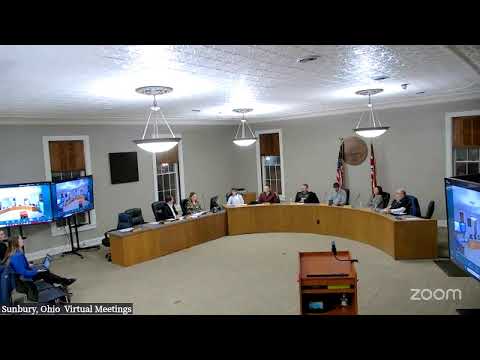
City Manager Hennessy walked Sunbury’s Finance Committee through preliminary financing scenarios on Jan. 15 for a planned wastewater treatment plant expansion, saying the city has two bids in hand and that the total project cost (including contingency, contract administration and inspection) now looks “somewhere between $32,600,000 and $34,100,000.”
City Manager Hennessy walked Sunbury’s Finance Committee through preliminary financing scenarios on Jan. 15 for a planned wastewater treatment plant expansion, saying the city has two bids in hand and that the total project cost (including contingency, contract administration and inspection) now looks “somewhere between $32,600,000 and $34,100,000.”
The presentation set out two borrowing terms — 30 years and 45 years — and conservative revenue assumptions. “We do have 2 bids in hand,” Hennessy said, noting a base bid of $30,200,000 and a base-plus-alternates bid of $31,620,000. He listed alternates that include a covered sludge-storage facility and a building renovation that would add lab and office space for operations staff.
Why it matters: the committee must decide how much to borrow and how to cover annual debt service estimated in Hennessy’s model at roughly $1.4 million (shorter term, base-plus-alternates) to about $1.0 million (45-year term, base bid only). The discussion laid out revenue sources the city expects to rely on — tap fees, an industrial reservation tied to east-side development, new community authority (NCA) receipts, a $2,314,000 water-and-wastewater infrastructure grant, and a possible draw from the utility fund.
Hennessy described the assumptions behind the cash-flow model: an annual tap-fee income of about $681,600 based on 100 new residential taps per year, a $6,500,000 balance in the utility fund with a modeled working balance of $2,300,000 after short-term needs, and a contingency of 5 percent for construction costs. He cautioned that some revenue items depend on development: the industrial reservation and NCA receipts are contingent on a development agreement and the type and timing of projects on Sunbury’s east side.
Committee members challenged and refined the assumptions. Mayor Mary Saint John said she supported including the building renovation alternate for operations staff, but called the $470,000 price for a covered sludge storage building “a lot of money.” “If you’ve seen our sludge storage, it’s basically a metal shelter,” she said. Hennessy and other members noted the city could pursue smaller, interim fixes — for example, contracting for more frequent sludge removal — while continuing to evaluate the alternates.
Several members praised the conservative approach. Finance Committee member Monique Cooper said the model’s flat tap-fee assumption is likely conservative and expected capacity/capacity-fee adjustments in future rate studies. Another committee member observed that NCA receipts depend heavily on what is ultimately built on the east side and on policy decisions about how such receipts are spent; historically, he said, the city has not used NCA revenues to pay sewer debt.
Hennessy also ran a capacity exercise showing the proposed expansion (from about 1,125,000 gallons per day to 2,000,000 gpd, an additional 875,000 gpd) and converted that added capacity into “equivalent dwelling units” for planning. Using conservative water-use assumptions (200 gallons per day per household), the model allocates roughly 60 percent of new capacity to west/north residential and commercial growth and 40 percent to east-side industrial demand.
Other items discussed included a $2,314,000 infrastructure grant already received; a $6.5 million utility-fund balance the city could partly draw to reduce borrowing; a contingency set at 5 percent; and value-engineering opportunities that could reduce costs as the design-review and construction process proceeds. Hennessy said the city’s earlier preliminary financing filings to Ohio EPA or the Water Development Authority assumed a 30-year structure, but the 45-year option had become available after bids returned higher than expected.
The committee also discussed non-capital ways to increase effective capacity, including addressing inflow and infiltration in the Cheshire Ditch and increasing the frequency of sludge removal. Hennessy said the city has budgeted to camera the sewer line this year to identify needed repairs and that fixing inflow/infiltration could effectively increase capacity without major construction.
Timing and next steps: Hennessy said the city expects to recommend a contract award to Council in about two weeks if bid review proceeds as planned, and contractors told staff they could mobilize within three to four months of contract award. Hennessy estimated a roughly 2½-year construction period and said the city will not begin debt service until the project is complete. “We will definitely see action on that plant this year,” he said.
Separately, Hennessy reminded the committee that the city had a second reading on proposed utility-rate changes on the agenda: a 3.5 percent increase to the sanitary sewer user fee and a 3 percent annual increase to connection (tap) charges. Hennessy told the committee staff would need formal action on those ordinances at the council level to implement changes in the next billing cycle; no committee vote on those ordinances was recorded in the committee discussion.
Decisions recorded in the meeting: the committee approved the minutes from its Dec. 18, 2024 meeting and later voted to close the meeting. No formal committee vote on the wastewater financing plan, contract award or the utility-rate ordinances was recorded in the transcript.
The committee asked staff to refine assumptions, confirm whether the state financing terms allow early payoff or prepayment, and reconsider the sludge-storage alternate price and other value-engineering options before the council vote.
Ending: Committee members expressed general support for a conservative financing approach and for building capacity large enough to avoid another immediate expansion. Several members emphasized the need to avoid saddling future councils with unmanageable long-term debt while also addressing immediate repair needs at the existing plant.