Get Full Government Meeting Transcripts, Videos, & Alerts Forever!
Get email alerts on the Land Use Subdivision topic
No spam. Unsubscribe anytime.
Planning staff proposes R‑4 cluster option to allow well-and-septic development with 75% open space
Summary
Fluvanna County planning staff proposed a zoning amendment to allow a cluster-development option in the R‑4 district that would permit well-and-septic systems with smaller lots and a high open-space requirement. The Board of Supervisors agreed to consider the proposal and asked staff to prepare ordinance language for advertisement.
Planning staff presented a proposed amendment at a Fluvanna County Board of Supervisors work session to create a cluster-development option in the R‑4 zoning district that would allow well-and-septic systems while requiring a larger percentage of open space.
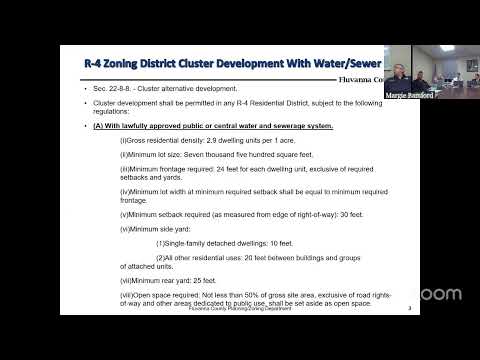
Under current county language, staff said, R‑4 lots on well and septic are limited to a density of one dwelling unit per two acres with a two-acre minimum lot size. The proposal would add an alternative cluster option in R‑4 allowing roughly one unit per acre, a one-acre minimum lot size, 60 feet of frontage and a 30-foot setback, with a 75% open-space requirement. "It gives you a little more density, and then a little smaller lot size, but you gain that 75% open space," staff said.
Staff contrasted the proposed R‑4 cluster-on-well option with the higher-density cluster option that depends on central water and sewer. When central water and sewer are available, staff noted, cluster development can approach roughly 2.9 units per acre with a smaller minimum lot size and a 50% open-space requirement. The proposed R‑4 cluster-on-well option would preserve larger minimum lot sizes than the rural-cluster pattern while enabling more open space than typical suburban subdivisions.
Supervisors asked technical questions about how gross and net densities would be calculated, whether roads and required infrastructure would be deducted from the buildable area, and how well and septic systems would be sited and permitted. Staff said roads and infrastructure could be located inside designated open space where appropriate and that specific stormwater, well and septic standards would remain subject to state and county permitting requirements.
Several supervisors supported adding the option as a "middle ground" between large-lot two-acre developments and denser, sewered cluster subdivisions. One supervisor objected to previous rural-cluster rules that allowed a single dwelling within designated open space; staff proposed removing that allowance so open space would not contain private houses.
Next steps: staff will return to the Board with draft ordinance language and, if the board agrees, request advertisement and a public hearing.
Ending: No ordinance was adopted at the work session. Staff will prepare formal language for Board consideration and possible advertising for a public hearing.