Get Full Government Meeting Transcripts, Videos, & Alerts Forever!
Get email alerts on the Infrastructure Roads topic
No spam. Unsubscribe anytime.
Council briefed on Tigard's pavement management program; staff outlines slurry, chip-seal and rehab priorities
Summary
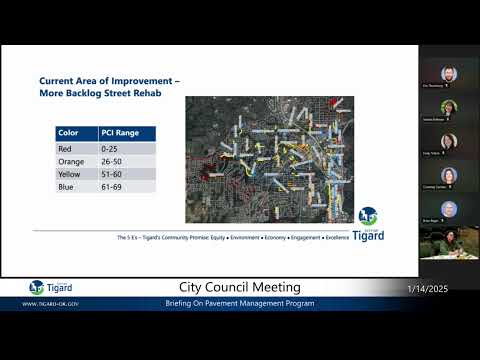
Project manager Nicole George briefed the council on Tigard's pavement management program Jan. 14, reviewing the city's pavement-condition index, treatment types (crack seal, slurry, chip seal, grind-and-inlay, full-depth repair) and planned 2025 work. Staff emphasized the long-term cost benefits of preserving roads at higher condition levels.
Project Manager Nicole George told the City Council on Jan. 14 that Tigard's pavement management program aims to maintain a citywide pavement condition index (PCI) near 80 by combining preventive surface treatments and targeted rehabilitation. The program is funded by the city's street maintenance fee, collected through utility billing.
"PCI is a scale of 0 to 100, and 0 being terrible and 1 being freshly paved," George said, and she reported the city's average PCI at roughly 80. She described the program's toolbox: crack seal, slurry seal for residential streets, chip seal for higher-traffic commercial corridors, grind-and-inlay for top-layer replacement, and full-depth repairs where subgrade or extensive damage exists.
Why it matters: Staff said keeping streets at a higher PCI gives better 'bang for buck' because preventive treatments (slurry and crack sealing) are cheaper than full-depth reconstruction. George said the city typically targets roughly 20 miles of pavement preservation work per year with an emphasis on coordinating utility and ADA ramp work before major pavement projects.
Recent and planned work - 2021–23 summary: Staff summarized recent seasons that combined slurry and rehabilitation work and noted efforts to address backlog residential streets while working with the streets crew on targeted dig-outs. - 2024 experience: The city piloted a chip-seal program on commercial streets (Hall Boulevard area and other corridors). Staff highlighted the need for prompt sweeping and a fog seal to reduce loose chips and enhance chip retention. - 2025 planning: Staff said rehabilitation projects will be packaged for bidding in March; the schedule depends on completion of utility work (Northwest Natural pipeline work referenced) and ADA ramp coordination. Planned work includes sections of Durham and other arterial and collector streets.
Public outreach and logistics George described the city's outreach for slurry projects: two-week prior neighborhood signs, no-park notices a week in advance, door hangers the night before and web/GIS mapping tools showing schedule details. She acknowledged residents' frustration over schedule changes and said the city will resume mailed notices in addition to web updates and work with communications staff to reduce confusion.
Ending: Councilors thanked staff and asked for the slideshow and maps to be posted to the city's website; staff said they will provide the slides and continue to coordinate schedules with utility partners.