Get Full Government Meeting Transcripts, Videos, & Alerts Forever!
Get email alerts on the County Budget topic
No spam. Unsubscribe anytime.
Lane County projects $6.3 million discretionary general‑fund shortfall for 2025–26; officials outline timeline and tradeoffs
Summary
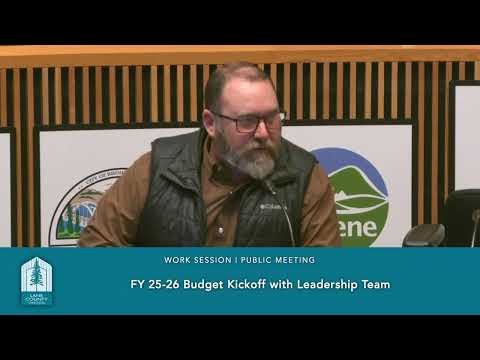
Lane County officials said at a budget kickoff meeting that the county faces a structural imbalance between revenues and expenses and that the county’s discretionary general fund is forecast to show a $6.3 million shortfall for fiscal 2025–26.
Lane County officials said at a budget kickoff meeting that the county faces a structural imbalance between revenues and expenses and that the county’s discretionary general fund is forecast to show a $6.3 million shortfall for fiscal 2025–26.
The shortfall reflects a combination of modest revenue growth — Christine Moody, Lane County budget manager, said property taxes are expected to rise roughly 3.2–3.5 percent — and faster expense growth (Moody projected 9.6 percent), driven largely by wage, benefit and inflationary pressures. "The 6,300,000 is the discretionary general fund deficit for 25‑26 projected at this time," Moody said.
Why it matters: County Administrator Steve Molkeriskey and other staff framed the problem as long‑running and structural. They traced the county’s fiscal position to decades‑long declines in federal timber receipts and to limits on local property tax growth that took effect in the 1990s and early 2000s. Those changes left Lane County with a lower permanent property‑tax rate than similarly sized Oregon counties while the county’s responsibilities and service costs grew.
Officials described the budget calendar and next steps. Departments must submit proposed budgets by late February; the county administrator will present a proposed budget in late April to the budget committee (five commissioners and five appointed residents), and the board is scheduled to adopt a final budget before the July 1 fiscal‑year start. Molkeriskey said central‑service areas (finance, human resources, technology, facilities and others) have been asked to prepare 5–10 percent reduction scenarios as part of a broader effort to identify options that minimize service impacts.
Staff warned that several items now funded with one‑time revenues will expire unless new funding is found. Moody identified roughly $4.5 million in one‑time expenditures that were included in current budgets — including temporary grant‑management positions and wildfire‑recovery staff — and said the forecast excludes those amounts when estimating the structural deficit for 2025–26.
The presentation also outlined longer‑running constraints: Lane County’s budget now totals roughly $1.2 billion and the organization employs about 2,085.9 full‑time‑equivalent positions. About 60 percent of county revenue comes from state and federal sources, Molkeriskey said, which makes state and federal policy and funding decisions particularly consequential.
Officials reviewed several policy levers and constraints. The county has limited authority to adjust its permanent tax rate because of state measures passed in the 1990s and early 2000s; staff and the board referenced historic reliance on O&C (Oregon and California) and U.S. Forest Service timber receipts and on Secure Rural Schools (SRS) payments that have since declined or lapsed. Moody said the county’s current budget conservatively budgets $3.7 million in timber revenue to the general fund; she noted timber receipts are volatile and that a renewed SRS program would shift the distribution and would be more beneficial to the county’s roads fund than to general‑fund ongoing revenue.
Public health, jail capacity and public safety remain among the largest discretionary general‑fund expenditures. Moody’s slides showed that roughly 78 percent of discretionary general‑fund dollars in the adopted 2024–25 budget supported public safety services; public health and general government consumed most of the remainder.
County Health and Human Services Director Eve Gray told commissioners the department is already operating under multiple pressures: clinic expansion following local hospital closure, rapid hiring to retain primary‑care capacity, rising labor and capital costs and uncertain state and federal funding flows. "We anticipated running a deficit," Gray said, adding that Health and Human Services has identified vacant positions and contract reductions but that the coming year will be "a bigger challenge to balance our budget."
Board members and staff discussed revenue strategies being pursued at the state level and the county’s internal options. Mary Brooks, the assessor and tax collector, urged investment in assessment and taxation staffing and technology to protect the county’s property‑tax base. She said assessment and taxation staffing is around 64 percent of the Oregon Department of Revenue’s recommended level and that targeted audits and inspections can increase long‑term revenue.
What’s next: staff will refine the forecast as departments submit budgets and as collective bargaining negotiations and state and federal budget actions become clearer. Molkeriskey asked departments to pursue reductions that preserve strategic priorities and to communicate rapidly with employees about possible changes.
The conversation was discussion and direction only; no board votes or formal decisions were recorded at the kickoff meeting.