
BZA approves three variances for 1817 Sheffield to allow rear addition, boxed bay and porch
Get AI-powered insights, summaries, and transcripts
Subscribe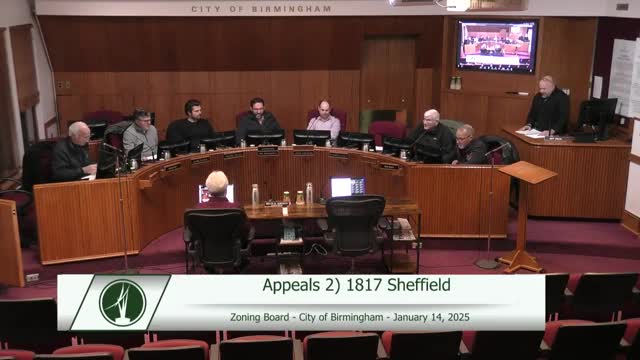
Summary
The Board of Zoning Appeals granted three variances for 1817 Sheffield (appeal 24-31) tied to submitted drawings; the property previously received relief in 1998 and the current request relies on the ordinance's 25-foot building-envelope provision for corner lots.
The Birmingham Board of Zoning Appeals approved three dimensional variances for 1817 Sheffield (appeal 24-31) that will allow a rear addition, a squared boxed bay on the second floor and a slightly wider front porch on a corner lot.
Staff presenter Jeff Zilke summarized the requests and ordinance references, saying the site is a corner lot subject to the ordinance's 25-foot building-envelope rule for corner lots (Chapter 126, Article 4, Section 4.61(a)(1)). The board recorded the specific variance requests as: variance a (street-side setback related to the 25-foot rule) at about 1.95 feet; variance b (proposed second-floor boxed bay) at 3.25 feet; and variance c (front porch setback) at 0.75 feet.
Architect Glenda Meads, representing the owners (Dr. and Mrs. Friesau), said the house previously received relief in 1998 and that, under the current ordinance's 25-foot building-envelope provision, the second-story nonconformity is "really only non conforming, 1.95 feet. We're filling that in flush all the way down where you see the columns there." Meads described the project as modest: the team plans to square and resurface an existing angled bay, fill in a ground-floor area beneath a column, and add a more rectangular front porch that better sheds water.
Board members questioned how the 1998 variance and the corner-lot building-envelope rule interplayed; staff and the architect explained the 25-foot rule reduces the effective required setbacks on corner lots and that the current requests largely formalize and tidy up prior changes. Kevin Hart moved to approve variances a, b and c tied to the submitted documents; the motion was seconded and passed on roll call (all members present voted yes). The chair declared the variances approved and congratulated the applicants. The approvals were explicitly tied to the drawings presented to the board.
Because the property had prior variances and the current request leaves the building footprint largely intact while updating appearance and details, the board found the requests consistent with the ordinance's variance criteria as presented at the hearing.