Get Full Government Meeting Transcripts, Videos, & Alerts Forever!
Get email alerts on the Zoning Procedures topic
No spam. Unsubscribe anytime.
Leon Valley planning commissioners review 71‑day rule, voting procedure and master‑plan guidance
Summary
At a Planning and Zoning Commission training, staff reviewed the 71‑day automatic‑denial rule for zoning applications, clarified how motions and recommendations are recorded, and outlined factors from the master plan and state law commissioners should use when voting.
At a Leon Valley Planning and Zoning Commission training session, staff and commissioners reviewed procedural rules for rezoning applications including the 71‑day automatic‑denial rule, how motions are recorded, and the role of the master plan in land‑use decisions.
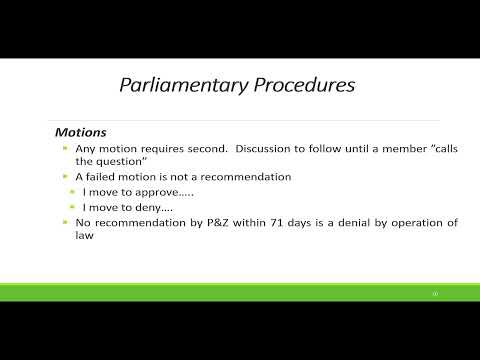
The training focused on three practical points that affect how the commission handles applications: (1) applications for rezoning or special permits are automatically denied if the commission does not issue an affirmative recommendation within 71 days; (2) a defeated motion is not the same as a formal recommendation to the City Council — the commission must vote affirmatively either to approve or to deny for a recommendation to be forwarded; and (3) the master plan (comprehensive plan) and compatibility with surrounding uses are primary factors the commission should cite when making recommendations.
Presenter/legal counsel explained the effect of the 71‑day requirement: "If an application comes in...you'll have 71 days in which to make a decision. If in the time that you don't make a decision, then it will be overruled by operation of law or denied by operation of law," and that an unresolved application is then reported to City Council. The presenter clarified that the 71‑day clock applies to applicant‑initiated rezoning or special‑use permit requests, not to general code or map revisions requested by Council.
Commissioners asked how a failed motion interacts with that timeline. The presenter underscored a consistent point from the commission's ordinance: "A motion which is defeated is not a recommendation. If a motion is defeated, another motion must be made, seconded, and voted upon and approved by a majority of the commission present in voting." In practice, that means a motion to approve that fails does not automatically become a denial to Council — the body must adopt an affirmative motion either to approve or to deny before a recommendation is forwarded.
The presenter walked through typical meeting procedure when a motion fails: discussion may continue, another commissioner can move to deny, move to table, or request additional information and continue the item to a future meeting. Commissioners were told they are not limited to one motion per item while the item remains before the chair.
On minutes and record‑keeping, staff explained the commission generally uses action minutes that list motions that passed, but the commission can request failed motions be included. "If at any point in a meeting there's something particular that you would like addressed in the minutes...you can always ask the staff if they could please make note of that in the minutes," staff said. The presenter noted video recordings also exist for the full record.
The training summarized legal and planning factors commissioners should consider when deciding rezoning or permit requests: consistency with the comprehensive/master plan; compatibility with surrounding zoning and uses; health and safety of the public; and the protection and preservation of property rights. Commissioners were reminded that these factors are the foundation of their recommendation and that some issues (for example, building code or other regulatory schemes) may be outside the commission's jurisdiction and are Council or administrative matters.
The presenter cited constitutional and statutory limits on zoning decisions, referencing the 14th Amendment (equal protection/due process) and the Texas Local Government Code as legal frameworks to keep in mind. The presentation included illustrative examples about potential equal‑protection concerns (for example, treating adult day care differently than child day care) and about consistency with the comp plan, observing that courts have sometimes reached different outcomes on similar facts.
Commissioners asked about the comp plan schedule and access to materials. Staff said the comp plan is available online and in the commission packets, noted that the code includes a provision recommending an update every four years, and that the commission can request printed copies or the PowerPoint used in the training. One commissioner reported the comp plan had last been adopted seven years earlier.
Practical takeaways conveyed to commissioners: confirm whether an item presented to the commission is a "discussion" or a request for a "recommendation" (the 71‑day clock is triggered by applicant requests); when a motion fails, follow with a clear affirmative motion (approve/deny) if the body intends to send a recommendation to Council; consider formally requesting failed motions or specific discussion points be included in the action minutes when that context may be important to Council; and use the comp plan and the enumerated factors as the primary analytical basis for recommendations.
The meeting closed with the usual adjournment motion. "Motion has been made and seconded. All in favor, say aye," after which the chair declared the meeting adjourned.