Get Full Government Meeting Transcripts, Videos, & Alerts Forever!
Get email alerts on the Redevelopment Ready Sites topic
No spam. Unsubscribe anytime.
Petoskey updates redevelopment-ready site list and hears housing experts on barriers to affordable units
Summary
City staff reviewed Redevelopment Ready Communities priority sites and invited Housing North to speak on incentives and barriers; councilmembers discussed site selection, height limits, incentives such as OPRA and historic tax credits, and the city's leverage over city‑owned lots like the Darling lot.
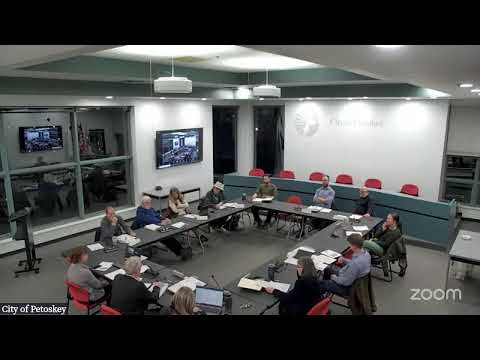
Petoskey City and the Downtown Management Board met Wednesday to review the city’s Redevelopment Ready Communities (RRC) priority sites, ongoing redevelopment prospects, and housing needs identified in the Bowen housing analysis.
Shane, a staff member leading the RRC item, said the list carried forward priority sites from prior certifications and noted some benefits of RRC status, including access to MEDC predevelopment funds and state marketing assistance. He listed high‑visibility and frequently discussed sites such as 200 East Lake Street, the Darling lot, 500 Howard Street (former Petoskey News‑Review site), the Bayview Road property (formerly a dealership), Spring Street retail centers, and the Continental Plastics/Barrow Brothers site on Sheridan as places the city is tracking for redevelopment.
Council members debated which sites to prioritize. Some council members urged removing or sidelining privately owned parcels where the owner has repeatedly declined to pursue development, citing 200 East Lake Street as an example. Several members said they supported keeping city‑owned properties such as the Darling lot as priority sites because the city can exert more control through an RFP process and public‑private partnerships. "If you have control over that property now, it can pave the way for you having control of the outcome versus offloading it to a private developer who could do whatever the heck they want," Lindsay Dotson, housing‑capacity staff, told the meeting.
Dotson, identified herself as Housing North’s housing‑ready coordinator for Emmet and neighboring counties, described tools and incentives available to communities. She noted the Bowen housing analysis showed a countywide gap and said reusing existing buildings often provides better value than building new because incentives are sometimes stronger for rehabilitation. "There are ways to kind of stack a lot of incentives that could be available with, some work through different programs that could greatly benefit any, housing projects in the downtown," she said, and recommended working with property owners who are willing partners while using RRC tools to attract developers and predevelopment resources for city‑controlled lots.
Councilmembers raised practical constraints on downtown affordable housing: height restrictions in core downtown blocks, the higher cost of new construction, and the need for subsidy to reach 0–80% area‑median‑income units identified as the greatest gap in the Bowen report. Several council members and the downtown manager noted that redevelopment proposals in recent years have stalled for reasons including market timing, interest rates and supply‑chain issues, and that approvals can expire if developers do not move to construction.
Staff offered examples of prior uses of state tools: the city has used OPRA (Obsolete Property Rehabilitation Act) agreements on several projects to freeze predevelopment property tax values during rehabilitation; the city also said MEDC RRC designation had helped secure predevelopment grants on Maple Block and Darling lot concepts.
Members asked staff to refine the priority‑site list and to continue outreach to developers who are actively pursuing projects. Several members suggested limiting the active RRC priority list to five to seven sites to focus staff effort, while others argued it can be useful to keep more sites on the list because the MEDC marketing benefit accrues without a large internal workload. No formal changes to the RRC list were adopted at the meeting.
The discussion closed with staff and Housing North offering further assistance to developers and the city in leveraging state programs and tax incentives; no formal votes were recorded on site additions or removals.