Get Full Government Meeting Transcripts, Videos, & Alerts Forever!
Get email alerts on the Parking Fund topic
No spam. Unsubscribe anytime.
Petoskey officials weigh using parking revenue for upkeep or a future parking structure
Summary
City staff presented a review of the parking fund showing rising revenue and a growing fund balance; council and downtown board members debated whether to spend on immediate lot repairs and downtown improvements or save for a future parking structure, with no formal vote recorded.
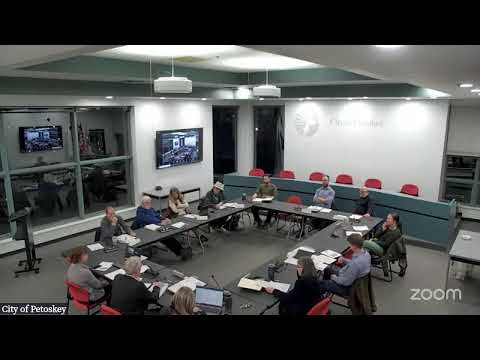
Petoskey City staff presented an overview of the parking fund at a joint City Council and Downtown Management Board meeting Wednesday, outlining projected 2025 parking revenues of $909,700 and a beginning projected fund balance of about $1.69 million.
The discussion focused on whether the city should use parking-fund balances and revenue increases to repair and maintain existing lots and downtown public amenities or continue reserving those increases for a future parking structure. Amy, a city staff member who led the presentation, said the fund’s 2023 balance was about $1,565,549 and that the increase in fund balance over a 2018 baseline was $741,848. “Our revenues are projected to be 909,700. Our operating expenditures are 789.7, and then our capital expenditures are 4.452,” Amy said, describing how planned capital projects would draw the fund into a negative position in 2025.
Council members and board members questioned the interpretation of the 2018 resolution that committed a majority of fee increases to a parking structure, asked for clarity on how much of the revenue growth resulted from rate changes versus increased usage, and pressed staff for lifecycle expectations on capital projects. Tina, a council member, asked whether the fund balance increase represented “the funds from that [2018] overture” or simply year-end surpluses; Amy replied the number is the net change in fund balance since 2018 and includes all revenue and expense effects.
Members highlighted competing priorities. Several council members said recent capital spending from the parking fund—façade grants, trolley repairs, sidewalk improvements, and restroom upgrades—has supported downtown revitalization. Mayor and some council members noted that maintaining public assets is an ongoing obligation and that substantial capital needs exist: staff estimated seven municipal lots will need at least $2.2 million over the next five years just for maintenance and updates. “If we're not going to do that and we're putting our money away to a parking structure, then there's really no reason for us to put parking fund projects in the CIP,” Amy said.
Other council members questioned the prudence of building a standalone parking garage without private development partners. “I continue to not be willing to support a standalone parking garage structure … the price tag that doesn't generate any tax revenue,” Mister Shields said, adding he has observed underutilized parking during busy periods. Several members favored pursuing mixed‑use redevelopment on city-owned lots, notably the Darling lot, rather than financing a large municipal deck solely from parking revenues.
Staff cited studies conducted after the 2018 rate increase that show parking‑structure costs “far out exceed” what the parking fund could cover and noted the city will need other funding sources for a structure. Amy said some proposed figures in planning documents are not engineered estimates. Members asked staff to return with clearer options and lifecycle estimates for capital needs and for consideration of amending the 2018 direction if council chose to change priorities.
No formal motion or vote on repurposing the parking fund was recorded at the meeting. After discussion, Amy told the group she had the clarification she sought from the boards and that staff would continue work on next steps.
The meeting also included related discussion on redevelopment priorities and housing (see separate article).