
BVSD begins first districtwide attendance-boundary review in 40 years, staff warns of limits and trade-offs
Get AI-powered insights, summaries, and transcripts
Subscribe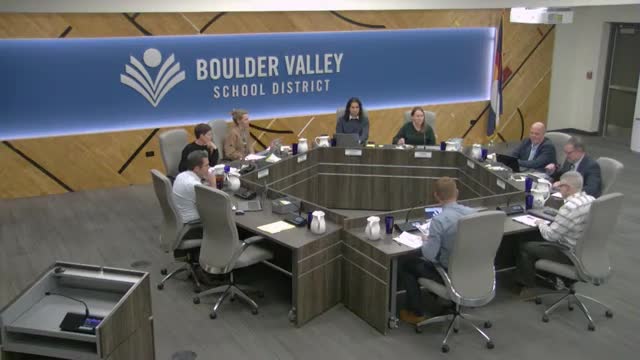
Summary
District staff presented a five‑year review of Policy JC and mapped noncontiguous and dual enrollment zones, telling the board boundary changes can address some enrollment imbalances but cannot on their own solve larger enrollment, program‑choice or equity issues.
Rob Price, Boulder Valley School District assistant superintendent of operations, opened a work session Tuesday laying out the district’s plan to begin a five‑year review of school attendance boundaries under Board Policy JC. The presentation noted the district has not done a comprehensive, districtwide boundary review in about 40 years and flagged several boundary types that complicate simple fixes: dual‑enrollment zones, noncontiguous pockets and split feeder patterns.
Staff said the review will prioritize student density relative to school capacity, balance of enrollments, pedestrian access, transportation efficiency and fiscal responsibility. “This is the start of that five‑year cycle,” Price told the board, adding staff will return with options and that the presentation was meant to solicit direction and data requests.
The nut graf: changing attendance lines can shift where resident students attend, Price and senior planner Glenn Segrue said, but boundary changes cannot control nonresident enrollment driven by school choice, open enrollment and specialized or focus programs. The staff presentation recommended a regional, multi‑factor analysis rather than isolated, neighborhood fixes.
Board members pressed staff for data and context. Several asked for open‑enrollment and capacity overlays, historical records, transportation implications and birth‑rate or housing‑development forecasts to understand future demand. Board member Alex said the district should analyze regions (for example, southwest Boulder) rather than treating each elementary school in isolation: “I’d like a regional characterization of all the data.” Board member Beth urged staff to show the origin of students attending magnet/choice schools, including Community Montessori, to see who is leaving neighborhood schools.
Staff described multiple persistent complexities. Segrue mapped dual areas around Bear Creek, Creekside and Mesa elementary schools and noted some dual zones date to school consolidations in the 1980s. He reported that the Bear Creek–Bear Creek Mesa dual area contains about 143 resident students (down from ~200 in 2018) and that families exercise open enrollment differently across those zones: “Of that 35 students, 22 are going to Bear Creek, seven to Creekside.”
Transportation and walkability repeatedly came up: board members asked which students receive busing when they live in a dual zone but choose the farther school. Price replied that for the Bear Creek area the district provides a single bus run to Creekside and that other students are generally within walk distance of Mesa or Bear Creek. Staff cautioned that route efficiencies are complex because the district runs multi‑tier bus routes and eliminating a route segment does not necessarily eliminate an entire bus.
Staff also identified “noncontiguous” pockets that were likely created as part of earlier rezoning or de‑stratification efforts. One example: two mobile‑home parks assigned to Whittier have historically been bused there, which staff said likely reflects 1980s policy choices. Another noncontiguous area appears to include CU graduate housing that currently sends few K‑12 students.
The presentation included a chart of resident student totals by school and noted five elementary schools with resident populations under roughly 300 — a threshold staff used as an approximate marker for a two‑section (two‑round) school. Staff emphasized that low resident counts do not always mean low total enrollment because open enrollment and program choices alter final school populations.
Price and Segrue pointed to future development areas (including Erie’s Parkdale site and CU‑related housing proposals) as possible student generators and asked the board whether staff should model multiple housing and birth‑rate scenarios. Several board members asked staff to incorporate a dashboard of current open‑enrollment flows, capacity, and feeder alignment in a February briefing and to return in March with options for board direction.
Ending: Board members asked staff to prepare regional data views, open‑enrollment overlays and scenario analysis and to plan community engagement before drafting specific boundary changes. Price told the board the next substantive materials — including an enrollment and open‑enrollment dashboard and a list of schools under the district’s engagement/advisory thresholds — will be available at the board’s February meetings and that staff would return in March with a narrower set of options for board direction.