Get Full Government Meeting Transcripts, Videos, & Alerts Forever!
Get email alerts on the Parks And Recreation topic
No spam. Unsubscribe anytime.
Conservation commission reviews Neal Park redevelopment, hears wetlands notice of intent
Summary
Para Corporation and consultants presented a Wetlands Protection Act Notice of Intent for a 4.6-acre redevelopment within Neal Park. Commissioners questioned buffer impacts, erosion controls and fencing; the public hearing was closed for later action.
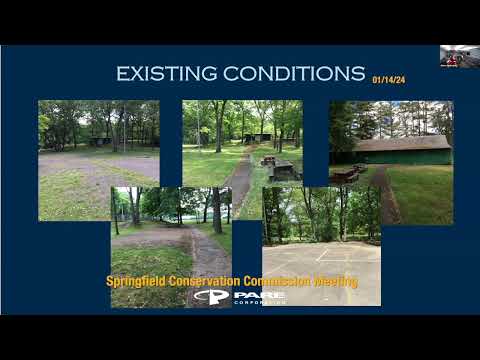
Mark McCluskey of Para Corporation presented a Wetlands Protection Act notice of intent Thursday for redevelopment work at Neal Park, a 21.5-acre parcel at 1708 Page Boulevard that includes the park named for U.S. Rep. Richard E. Neal.
"Good evening, members of the commission. My name is Mark McCluskey. I'm from Para Corporation," McCluskey said as he opened the presentation, which described replacing and reorienting recreational features and restoring an eroded embankment.
The commission was shown plans for a roughly 4.6-acre project area within the larger parcel that would add new and refurbished amenities — a relocated baseball field, a playground, a spray pad, a beach-sand volleyball court, a smaller pavilion, an ADA-accessible parking configuration and a new relief station — while keeping overall impervious cover nearly the same. McCluskey said the proposed work results in a nominal 915 square-foot net increase in impervious surface to accommodate new ADA parking stalls.
A commission environmental scientist on the project described wetlands and stream resources on the site and how those resources are buffered under the Wetlands Protection Act (WPA). The presenters identified two bordering vegetated wetlands and one perennial stream near the project area, noted the stream receives the 25-foot riverfront buffer and a 50-foot no-disturb buffer under the WPA, and said the BBWs (bordering vegetated wetlands) carry a 100-foot buffer. The filing was registered with the state as DEP file number 2294-0633.
Commissioners pressed the project team on erosion and sediment controls for an eroded overland flow area in the northwest portion of the site. The applicant described plans to fill and regrade a degraded overland channel, stabilize the embankment with articulating block protection, and install a cobble level spreader to reduce transport of suspended solids during overland flow. The applicant said no formal infiltration best-management practice is proposed and that the peak post-development flows and volumes will be equal to or less than existing conditions.
Fencing for the reoriented baseball field drew questions. The project team said fence heights will vary: standard backstops and sport-specific areas may be 10 to 20 feet in some locations, and the western edge fence adjacent to the reoriented field would be at least 6 feet and likely 10 feet where needed to limit fly balls entering the adjacent play area. The team said they would add netting or higher fencing where necessary.
Commissioners also sought clarity on how the riverbank and bankfull indicators were delineated and on the hydrologic soil-group data used in the stormwater analysis. The applicant said the delineation relied on breaks in slope where present and hydrologic indicators where banks were not well-formed, and that NRCS soil-survey data was used to select hydrologic soil-group values rather than on-site bore testing.
The public hearing portion of the discussion was closed by motion, which passed on roll call: Chairman Collins (yes), Vice Chair Martinez (yes), Commissioner Almeida (yes), Commissioner Miller (yes), Commissioner Ryan (yes) and Commissioner Bongiorno (yes).
Next steps recorded in the meeting record include the commission’s continued review of DEP comments and the project team’s written responses (DEP file 2294-0633). The commission did not vote on issuing or denying an order of conditions during the hearing and indicated it would consider the written materials and any recommended conditions at a subsequent meeting.