
Panel approves changes to juvenile collateral consequences, including permissive sex-offender registration and school-policy flexibility
Get AI-powered insights, summaries, and transcripts
Subscribe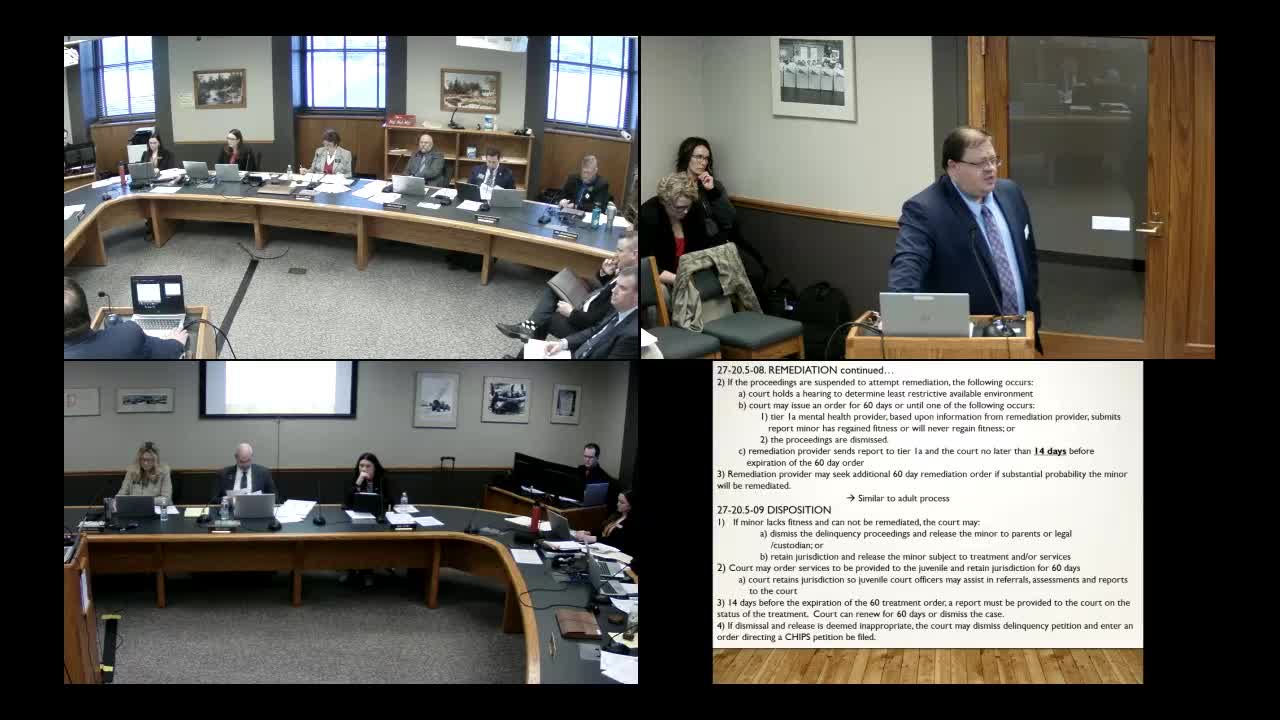
Summary
The Senate Judiciary Committee approved legislation to revise juvenile collateral consequences, including making certain sex-offender registration discretionary and allowing local school boards more discretion on suspensions for student misconduct.
The Senate Judiciary Committee on Thursday approved legislation that would revise a range of juvenile collateral-consequence rules, including making some sex-offender registration for juveniles permissive rather than mandatory, narrowing situations that trigger registration, and allowing local school boards more discretion on extracurricular suspensions.
Senate Bill 2037, drafted by members of the interim juvenile justice work group, consolidates several collateral-consequence provisions into a single section of the juvenile code and removes references to adult-class penalties from juvenile petitions, the sponsor said.
Travis Fink explained the bill’s major changes: it would allow the juvenile court to avoid treating certain peer-to-peer sexual conduct as the same as adult sexual offending where the conduct is consensual and the participants are close in age, create a three-year "Romeo and Juliet" age-gap provision for some offenses under age 15, move tobacco infractions for most juveniles into the juvenile system to preserve confidentiality, and make registration for certain offenses "permissive" — requiring registration only when specific findings (such as predatory conduct or prior adjudications) are present.
Fink told the committee the changes were intended to avoid saddling young people with long registration or firearm-disability consequences for nonviolent or developmentally typical adolescent behavior, and to provide courts discretion to protect children with confidentiality when appropriate.
Opponents urged caution on some provisions. Seth O'Neil of the North Dakota Domestic and Sexual Violence Coalition testified in opposition to narrowing the domestic-violence provision, arguing the change could remove a tool to charge juveniles who assault family or household members. The committee discussed that other criminal provisions (assault, disorderly conduct) remain available for prosecution when domestic-violence labeling is removed.
The committee adopted technical amendments from the court staff and voted to give the bill a do-pass recommendation; committee members also agreed to hold a subcommittee and to refer the bill to Appropriations given fiscal and implementation considerations where applicable.