
Healey administration unveils $8 billion, 10-year plan to stabilize Massachusetts transportation
Get AI-powered insights, summaries, and transcripts
Subscribe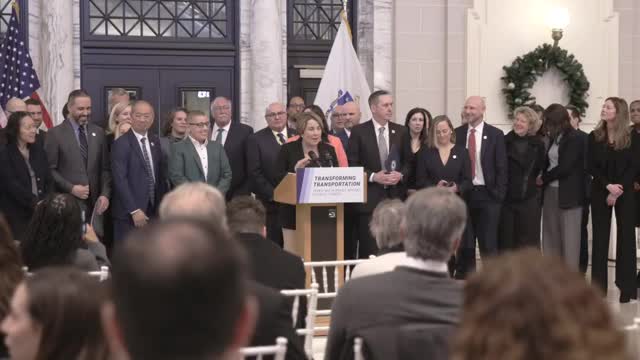
Summary
Governor Maura Healey announced a plan to invest $8 billion over the next 10 years to stabilize and upgrade transportation across Massachusetts, speaking at Union Station in Worcester at a public event where the administration released the Transportation Funding Task Force report.
Governor Maura Healey announced a plan to invest $8 billion over the next 10 years to stabilize and upgrade transportation across Massachusetts, speaking at Union Station in Worcester at a public event where the administration released the Transportation Funding Task Force report.
The announcement, the administration said, centers on maximizing newly available "fair share" tax revenues, deploying federal matching funds and borrowing against a dedicated transportation fund to pay for state and municipal roads, bridges, rail and transit. "This plan launches a new era in Massachusetts of sound management, sound vision, and great transportation for Massachusetts," Governor Maura Healey said.
The nut graf: The Healy-Driscoll administration presented a package of budget proposals it said would immediately raise operating support for the MBTA, fund capital projects statewide, and increase municipal road funding under Chapter 90. Officials described the package as a mix of transfers, borrowing and supplemental spending that requires further legislative action to implement.
Administration officials said the plan includes several specific steps. Matt Gorkowitz, secretary of administration and finance, said the administration will transfer $765,000,000 of fair share revenue in fiscal year 2026 into the Commonwealth Transportation Fund and use that base to borrow roughly $5 billion for capital investments over a decade. He also said the administration will file House 1 (the FY26 budget) next week and a supplemental budget to spend $1.3 billion in unbudgeted FY24 fair share surplus, proposing to dedicate $857,000,000 of that surplus to transportation.
"It will also allow us, on an annual basis, to more than double our operating support for the MBTA immediately addressing their budget shortfall and putting the T on a path for long term financial stability," Gorkowitz said. Administration materials and speakers tied those moves to closing the MBTA's budget gap and supporting local projects including culvert repairs, bridge replacements and Chapter 90 funding.
Monica Tibbets Nutt, secretary of transportation, said the FY26 proposal (House 1) would include a $2.2 billion investment intended to stabilize operations and improve service, with $500 million from fair share revenues. "House 1 proposes a $2,200,000,000 investment to stabilize operations and improve service quality, including $500,000,000 from fair share revenues," she said, and described funding that would support the MBTA Academy, Low Income Fare Relief and regional transit authorities (RTAs).
MBTA General Manager Phil Lang said the MBTA's operating budget would rise significantly under the administration's proposal, citing an operating increase to $687,000,000 in fiscal 2026 to address the MBTA's shortfall. "This is a game changer for the agency," Lang said, adding the funding would be used to upgrade rolling stock, improve signals, enhance station accessibility and build resilience across the system.
Kate Dineen, president and CEO of A Better City and a task force member, said the task force report informed the proposal and stressed statewide reach: "These operating and capital investments will touch every corner of the Commonwealth, not just the T in Greater Boston, but also our RTAs and our roads, bridges, tunnels, culverts." Dineen and other task force members described the recommendations as fiscally actionable and intended to leverage federal funds.
Worcester City Manager Eric Bautista welcomed the announcement and tied the proposal to local priorities, noting Worcester's role as a transportation hub and the city's Chapter 90 allocation for FY25. "$8,000,000,000, that's a big deal, and we should all be extremely proud and excited about that," Bautista said.
Officials outlined additional numeric targets and programs: an increase in Chapter 90 municipal funding to about $300,000,000 annually over five years, using federal matching to retire portions of MBTA legacy debt, and proposed borrowing against the Commonwealth Transportation Fund to deliver roughly $5 billion in capital over 10 years. The administration said fair share revenues produced about $2.46 billion in FY24 and called the surtax a new revenue source that can be deployed without raising additional taxes.
What changed and what remains: The announcement is a policy and budget proposal rather than a final legislative package. Administration officials repeatedly framed the plan as dependent on forthcoming budget filings and legislative approvals; the event included no formal votes. Officials said implementation will require continued work with the legislature and federal partners.
The announcement follows a year of work by the Transportation Funding Task Force, convened by executive order. Officials credited federal grant success and increased federal funding as part of their ability to propose the plan. Governor Healey closed by calling the effort foundational: "If we didn't deal with stabilization, if we didn't deal with the foundation, which has been crumbling for decades, we're not gonna get a chance to build anything meaningful."