
Greeley-Evans School District 6 launches AI task force, schedules teacher training Feb. 3
Get AI-powered insights, summaries, and transcripts
Sign Up Free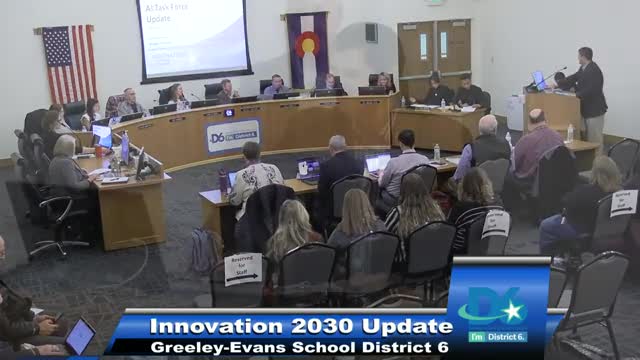
Summary
Board hears update on AI task force tied to the district’s Innovation 2030 strategic plan; district selected as one of eight statewide partners with Colorado Education Initiative and working with Magic School, IBM, AIEDU and Spark Fund; 17 educator fellows and a Feb. 3 professional development session were announced.
At the Jan. 13, 2025 meeting of the Greeley-Evans School District 6 Board of Education, Assistant Superintendent Anthony Ospous updated the board on a newly formed artificial intelligence task force that will guide teacher training and pilot classroom AI tools tied to the district’s Innovation 2030 strategic plan.
Ospous said the task force aims to support educator instructional practices, promote equity of access and implement a professional development plan so teachers and students can use AI “ethically” and evaluate AI output for accuracy. He told the board the initiative is part of a Colorado Education Initiative (CEI) grant that selected District 6 as one of eight statewide partners.
“The states in purple are already seeing a decrease, a significant decrease in jobs due to AI,” Ospous said while describing workforce shifts and why the district is preparing students for an AI-driven workplace. He added the district must teach students and staff to use AI as an idea generator rather than an assignment-completer.
Dr. Degan Andrews, director of curriculum, instruction and assessment, described four industry and nonprofit partners supporting the work: Magic School, IBM (Skill Builder), AIEDU and Spark Fund. She said the district currently has 17 fellows—16 teachers and one instructional coach—receiving in-depth training; 11 fellows are training with Magic School, two with IBM Skill Builder, and four on both platforms.
Caleb Flores, secondary coordinator for multilingual learners, demonstrated classroom uses, including using Magic School to translate a short poem for students new to English and to scaffold complex assignments without lowering rigor. Flores cautioned that AI outputs can contain errors: in one visual aid generated for a scaffolded assignment he noted “a lot of misspelled words” on the AI-produced image and said teachers must remain “vigilant.”
Ospous said the district will offer a first round of AI professional development for secondary educators on Feb. 3, led by teacher fellows, and is piloting an “Introduction to AI” course for students. He emphasized the district’s intent to balance efficiency gains for teachers with instruction on ethical use and accuracy checks.
Board members thanked staff for the work. Director Campos Spitzy said professional development is critical because students often learn new technologies faster than teachers. The board did not take any formal action at the meeting on the task force update.
The district framed the effort as part of Innovation 2030’s Student Learning and Achievement goal; staff presented the update as an early-stage implementation step that includes partnerships, fellowships and scheduled PD.