Get Full Government Meeting Transcripts, Videos, & Alerts Forever!
Get email alerts on the House Organization topic
No spam. Unsubscribe anytime.
House adopts temporary rules, joint rules and names committees; introduces initial bills
Summary
On opening day the House adopted temporary house and joint rules, appointed committees to notify the senate and governor that the chamber is organized, published committee assignments for key reference committees and introduced an initial set of bills to be assigned to committees.
The Colorado House of Representatives adopted temporary rules for the 75th General Assembly, approved joint rules and completed a round of organizational business including committee appointments and the introduction of the first set of bills.
The chamber adopted House Resolution 101 to use the temporary rules from the previous General Assembly as temporary rules for the 75th; the motion carried by machine vote with 63 ayes, 1 excused and 1 vacant. The House then moved to notify the Senate and the governor that it was organized and ready for business and appointed small committees to deliver those notices.
The House also considered and adopted Senate Joint Resolution 1, which designates the previous joint rules as temporary joint rules for the new session. The machine vote for that adoption was recorded as 63 ayes, 1 excused and 1 vacant.
Clerk Mister Schiebel read appointments to committees of reference and the Joint Budget Committee. Chairs and vice chairs named in the reading include Karen McCormick (Agriculture, Water and Natural Resources), Emily Sirota (Appropriations), Nikquita Ricks (Business, Fairs and Labor), Megan Lukens (Education), Alex Valdez (Energy and Environment), William Linstead (Finance) and Javier Mabry (Judiciary), among others. The Joint Budget Committee membership read included Shannon Bird (vice chair), Emily Sirota and Rick Taggart.
The House introduced an initial set of bills, roughly 20 on opening day, which Schiebel read for the record. Noted introductions included bills on wage-and-hour enforcement, mental-health health-benefits coverage, a Medicaid waiver for children with complex needs, landlord pricing coordination prohibitions, tax incentives for supporting film festivals, school district property leases, paratransit services, incentives for jails to provide behavioral health services, vegetative fuel mitigation, and a price-gouging prohibition. Each introduced bill was assigned to a relevant committee for consideration.
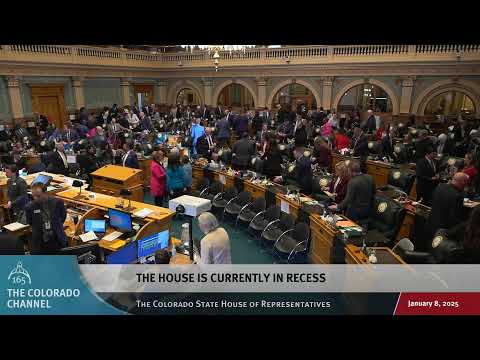
After completing initial introductions and organizational votes, the House recessed until later the same day to continue business and to allow committees to begin their organizational work.