Get Full Government Meeting Transcripts, Videos, & Alerts Forever!
Get email alerts on the Election Certification topic
No spam. Unsubscribe anytime.
House affirms credentials report, rejects objections to 2024 election certification
Summary
On opening day the Colorado House adopted the credentials committee report and certified the results of the November 5, 2024 election after members debated alleged cybersecurity lapses; the roll-call vote was 57 in favor, 6 opposed, 1 excused and 1 vacancy.
The Colorado House of Representatives adopted the report of its Committee on Credentials and certified the results of the Nov. 5, 2024 general election after a floor debate about election cybersecurity and the public posting of passwords.
The action came after a motion to adopt the credentials committee report and its finding that the persons listed by the secretary of state were duly elected. The motion carried on a roll-call vote of 57 in favor, 6 opposed, 1 excused and 1 vacant.
The vote followed objections from some members who said security lapses undermined confidence in election systems. Representative De Grama raised statutory and federal-security claims, saying state code SB22-153 (codified into CRS 1-13-708), USC 44-3572 and Colorado’s voting system standards (CRS 1-5-6 or 1.5 as cited) require stronger protections and retention of audit logs. He argued a BIOS-password compromise tied to the May 26, 2023 certification undermined the “gold standard” security claim and said records required for post-election review had been deleted, citing federal standards such as NIST 800-53 and FISMA in his remarks.
Representative Bottoms objected to certification on the floor and said the public posting of passwords had left the state vulnerable, calling for criminal investigations of the Secretary of State’s office. "When the passwords were released, they were released to every county except one," Bottoms said. "I don't have proof that any of those passwords were used to do anything. Nobody else has proof of that. But I think it would be naive to assume that at least one person did not change at least one vote."
Speaker Pro Tem Basenecker, speaking for the chamber during the exchange, urged adoption of the credentials report and warned against prolonging election denialism. Basenecker said the posting was a "serious incident" the secretary of state's office regretted, but added, "No voting machines in the state of Colorado were tampered with." She cited post-election checks of access logs, bipartisan confirmations from county clerks, mandatory post-election audits and two investigations — one by an independent law firm and another by the Denver district attorney's office — that the transcript records identify as having examined the incident.
The Committee on Credentials had earlier reviewed the Secretary of State’s certification and reported that the list of representatives elected on Nov. 5, 2024, was "a true complete and authentic list" and that the listed persons met constitutional and statutory qualifications to be seated.
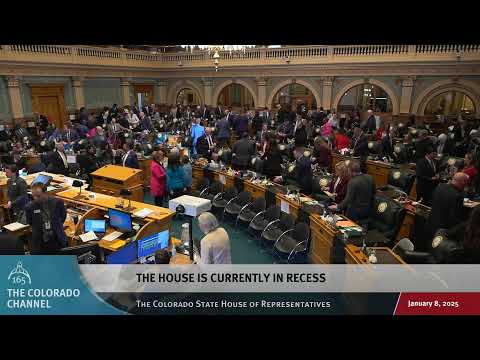
The House proceeded to a roll-call when an objection to a voice vote was raised; because members had not yet been sworn in they could not use the electronic voting system and many names were called aloud during the count. The final tally recorded in the chamber was 57 ayes, 6 nos, 1 excused and 1 vacant, at which point the motion was declared adopted.
Members who raised objections framed their concerns principally as stemming from cybersecurity and records-retention issues and urged further investigation; supporters of adoption emphasized audits, recount procedures, and the lack of evidence that tabulation was altered. The House did not adopt any additional investigatory direction on the floor at the time of the vote; the certification motion itself was limited to adopting the credentials committee report.
Following adoption, the House moved on to organizational business including notifying the governor and senate that the chamber was organized.